Hospitality Suite

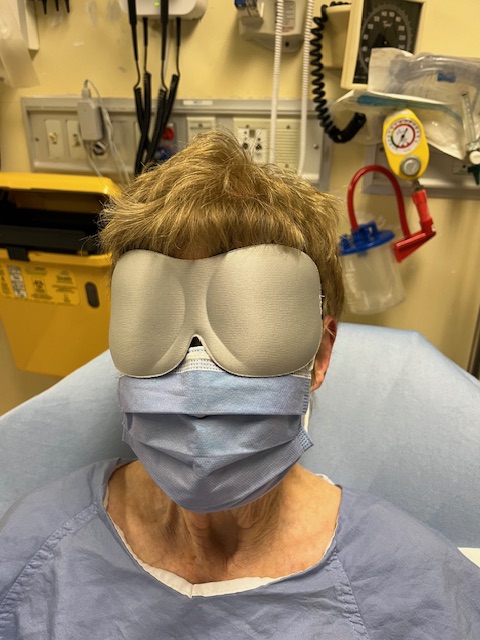
Last week I was feeling kind of tired so I decided I needed a vacation. I managed to secure a negative ECG and booked into the Toronto General Hospital.

My first accommodation was in the emergency department, aka pretty basic. The cubicles were all full so I was given a room in the Hall. I got a lot of attention there, some of it uninvited. The patient across from me in the hall was a little needy and called out for the nurse all night. When nobody came immediately, she climbed out of bed and roamed the halls calling “Nurse, Nurse!”

At 4:30 am the floor cleaning machine came along, over and over again, washing and polishing the floors. After that was finished, I was moved into a cubicle, which is really part of the hall but with a curtain around it. The noise level was the same but I had a little privacy for when my hospital “gown” came undone. The nurses visited often for blood pressure checks, ECG’s, IV installation, and medications. It was pretty hard to sleep even with all my equipment.

At breakfast time I was handed a paper bag with a cup of orange juice, and a box of Shreddies with a carton of milk. And No Coffee! I was starting to think I had booked the wrong travel agency. Until… a staff member with a wheelchair picked me up and told me I was going from the “madhouse to the penthouse!” And he was right.

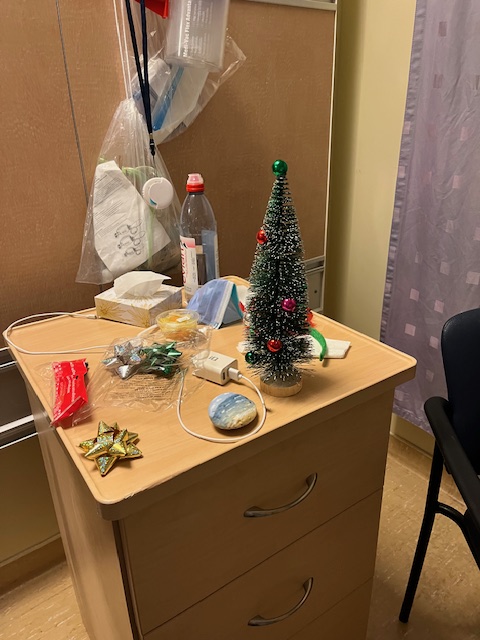
I was whisked up to the 5th floor, cardiology, and into a private room. It was large and sunny with a big window, a dresser, a bedside table AND my own bathroom! Now this was living. Well almost living, except for my heart acting up. I continued having test of all sorts and visits from cardiologists who would talk to me separately and then have a conference with each other outside my door. It’s hard not to eavesdrop when that happens but, since they were speaking in medical language, I had no clue what they were saying!

Gradually the doctors and tests all arrived at the same conclusion – I needed a pacemaker. Basically I needed to be jump-started with an inside battery. Now that I was nearing the end – to my treatment that is – I was moved again, this time to a semi-private room. I still had a window, and a bathroom that I didn’t have to share because the other patient in the room was bed-ridden. And there was a lovely lounge area nearby overlooking University Avenue. By this time the food was much more edible, and served on a tray with real dishes and cutlery. I still wasn’t seeing any margaritas, but the Greek salad was quite tasty.

After my pacemaker was installed, I stayed one more night and then went home just in time for a new patient to settle in and watch the Santa Clause parade. My experience was a different kind of vacation. The staff were all friendly and helpful. The service was efficient. But what I’ll remember most? Whether in the hall or the penthouse or anywhere in between – I had family and friends texting, phoning and visiting. That part was the best!

Sue

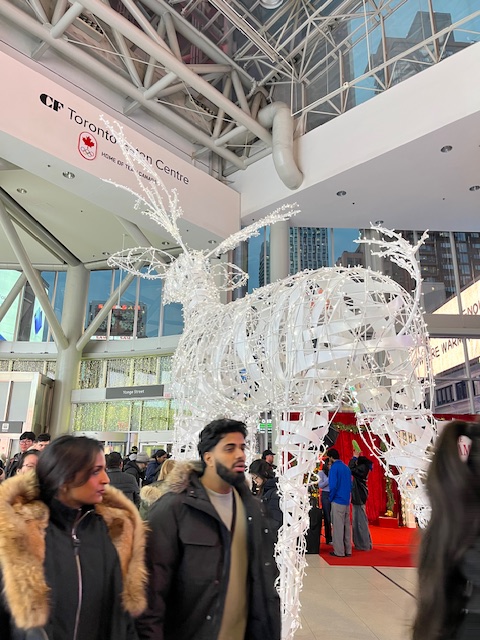
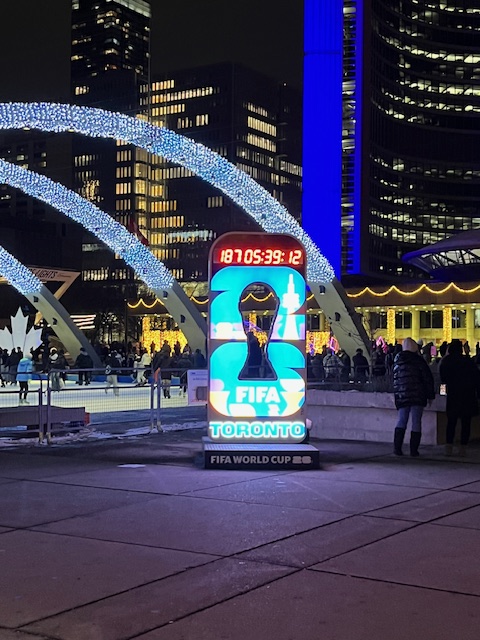
Here’s my grand daughter Agnes’s contribution: Christmas decor

Where Is Annie?

Last weekend Peter and I went looking for a cemetery. “Now why would we do that?” you ask. Was I so desperate for material?

The truth is that a friend and I belong to a book club where the author speaks to us in person, and we always feel obligated to read the book. Plus they serve cookies and tea before the meeting. The title for November caught my attention: The Knowing; A History of Canada Through the Indigenous Lens. What was a “knowing” anyway?

The author, Tanya Talaga, explains early in the book about what a “knowing” is. In a nutshell it’s a body of thoughts or facts that everyone knows to be true, but is not documented or published. I guess, for example, that all adults know that they themselves play the role of Santa at Christmas. But they would never disclose this secret because it would break the hearts of many little children.

In the Indigenous culture there is no Santa. But the people have known for years that their children were stolen from them and often died as a result of their lives in residential schools. It was a well-hidden “knowing” until 215 when remains were found on the grounds of the Kamloops residential school. The Canadian government kept it a secret because of their involvement, and the indigenous people didn’t discuss it openly because that would confirm their sad reality.

But ground-penetrating radar equipment uncovered the truth. Stories emerged of staff abusing children, sending them fishing in unsafe canoes and allowing them to drown, giving them polluted water to bathe in and even drink. School officials filled the schools to overflowing so they could collect the $4 annuity the children received. Medical care was non-existent and a lot of the students died of tuberculosis in the damp cold buildings.

As Talaga learned about this terrible truth, she wondered about her own family and began to trace her ancestors back to the 1800’s. One person eluded her: Annie, her great grandmother. Talaga discovered that Annie married twice and had 7 children, five of them “lost.” But after Annie reached the age of 60, she seemed to disappear. Was she one of the bodies buried somewhere in an unmarked grave?

Talaga’s research was meticulous and widespread. She travelled from James Bay where Annie was born in 1871 all the way to Saskatchewan where Annie lived with her second husband. Talaga visited libraries and document centres, and she searched out contacts. She read and re-read the Indian Act of 1887 and many other treaties and agreements. She even found data that had been collected by official inspectors and then discarded. All her work led her to Annie and her life until she was about 60. Then she seemed to disappear. Where had she gone?

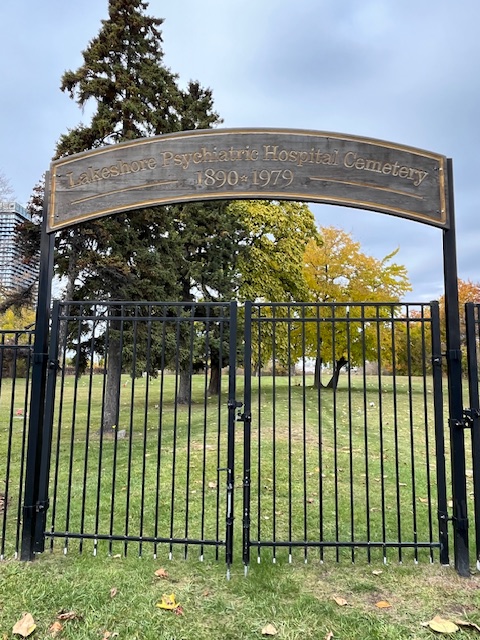
Through a contact, Talaga had a lucky break. She was able to follow Annie’s trail to the Lakeshore Lunatic Asylum in Etobicoke, where older Indigenous people without family support were placed. (The building was later re-named the Lakeshore Psychiatric Hospital). Many residents died there from disease and old age and the hospital needed a place to put their bodies. They took over some vacant land, about 3 kilometers away from prying eyes. The patients themselves cleared the land and dug the graves. Annie was buried there in 1937.

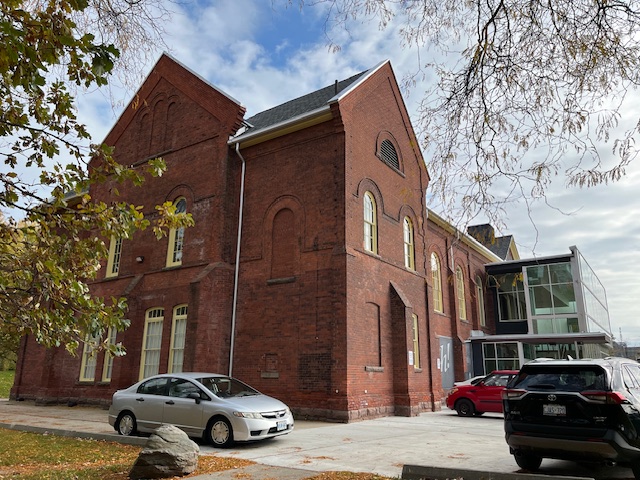
Ninety years later I found out about Annie’s grave in our neighbourhood, and coerced Peter into making a visit to find Annie again. We know the former hospital. It has been bought by Humber College and sits on the Lakeshore campus, serving as an assembly hall. Several movies have been filmed there including Richard Burton in Equus, and the Police Academy series.

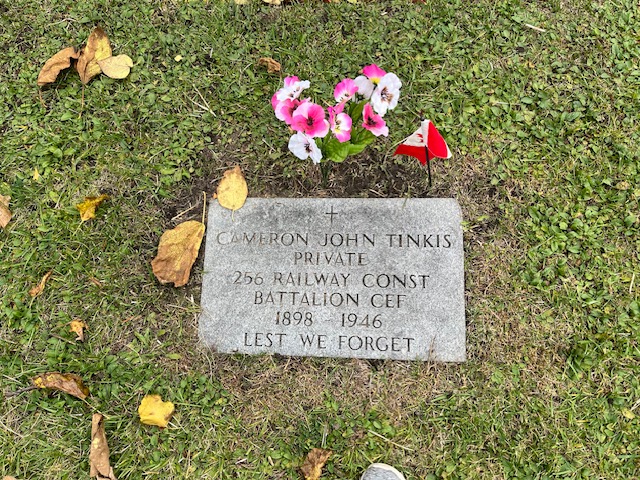
The cemetery, which is located at the corner of Evans and Horner Aves, has been resurrected by volunteers and local councillors. More than 1500 graves are now numbered so that visitors can find loved ones. On Remembrance Day it is fitting to mention that 24 of them are WWI veterans and those graves have names and Canadian flags. It’s a quiet place where Annie and others have found peace at last.

The Indigenous “knowing” is now ours too – just a few kilometers from our doorstep.

Sue

Happy Birthday

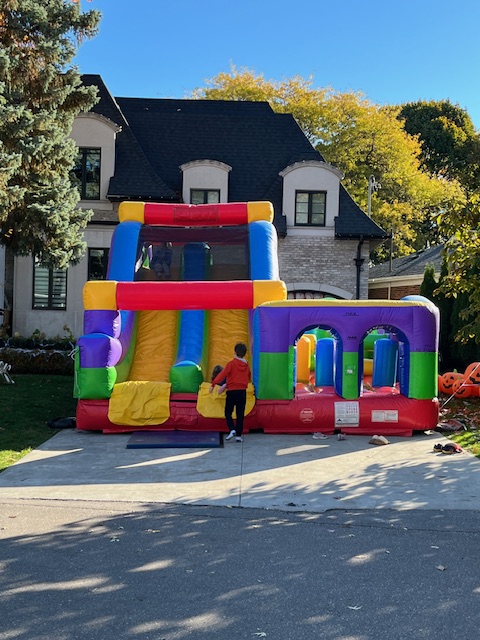
The sadness that enveloped many Canadians after the heartbreaking loss of the Blue Jays was not shared by everyone. The next day our neighbours hosted a gigantic birthday party for one of their children.

It got me reminiscing about birthday parties I have known in the past. When I was a kid back in the 1950’s, parties were pretty simple. I was allowed to have 5 or 6 friends at our house. The guests brought simple gifts like candy. One year I got a 45 rpm record – my first – Buddy Holly singing Peggy Sue. I played it till there were no grooves left.

My mom served sandwiches; the favourites were peanut butter and banana pinwheels. One year Mom got the idea to tint the milk pink. Everyone loved that milk. One girl got a stomach ache from drinking too much. Mom also used to wrap nickels and dimes in saran wrap and hide them in the cake batter. All the kids ate a lot of cake, hoping to get rich.

When my own children came along, birthday parties were becoming a little more elaborate. Parents figured out that hosting parties outside the home created a lot less mess to clean up. My kids, Jennifer and Jamie, were born 3 years apart, but both birthdays were only 2 days apart, in January. I tried hosting both birthdays at home on the same day, the older girls in the family room, and the younger boys in the rec room. It was pretty chaotic with the boys spying on the girls and the girls screaming out in protest.

The next year I took them all, 2 sets of 6 kids each, to Chuck E Cheese; the location that was recently featured in the Toronto Star. I also persuaded a couple of other parents to join us and help supervise. They must have been very good friends. The kids all got their share of “coins’ to use playing various games. They could run back to our table periodically to grab a slice of pizza or a drink. The party worked fairly well and we didn’t lose a single child. But one tiny girl somehow got back to the car with only one boot on. Everyone waited as I ran back to the restaurant, and crawled around on my hands and knees until I found the other one.

Chuck E Cheese

Another year I rented a Toronto Parks and Recreation pool for a hour. It wasn’t very expensive, maybe $50 back then, and it was an activity the kids couldn’t normally do in January. Twelve kids in a huge pool meant there weren’t any territorial arguments, and there was a lifeguard so nobody drowned. But there was a lot of sorting of wet clothes in the dressing rooms. And then they had to go back to our house for the food anyway.

I have to say that I was relieved when Jen and James grew old enough to sort out their own birthday arrangements with friends. I tried to pretend they were celebrating in a nice restaurant instead of drinking beer in a rowdy pub.

But last Sunday our neighbours hosted a party beyond belief. The front yard was already decorated to the max with Hallowe’en stuff: ghosts, spider webs, skeletons, a pumpkin family, a motion-activated scary-looking guy at the door yelling ” Beware!!” Then along came a large truck that began spewing out parts and blowing them up.

A huge structure began to take shape in their driveway. Was it a bouncy castle? I went to have a closer look. I found a maze of towers and balls that led to blow-up stairs. At the top of the stairs was a double slide as high as the second storey of the house. The view up there must have been amazing. The neighbourhood kids came to have a look too. They lined up to try out the slides. I was tempted to join the line, but then more birthday party kids began arriving in cars.

I retreated to the safety of our front window where I could watch; and think back to the good old days when parties were a lot simpler. All you had to do was tint the milk pink.

Sue

Go Jays!

What else did you think I would write about? Canada has a team in the World Series, for heaven’s sake! It’s Canada vs the US in yet another domain.

The day our team qualified took me back to my teens. My dad played baseball as a kid, and he was a huge fan of the game as an adult too. He brought his family along for the ride. During every world series it seemed to be always the same 2 teams: the Yankees vs. the Dodgers. Only it was the Brooklyn Dodgers back then. Dad used to organize a “pool” and family members would pay big money, like 25 cents, to buy a ticket. Excitement was in the air.

Dad never got to see the Skydome, aka Rogers Centre, built in 1989. He developed vascular disease in his later years and had mobility issues. He died just before the World Series of 1993. I would have paid scalper prices to take him to one of those games. Since then, Peter and I have become fans and we buy a six-pack every year – 2 tickets to 6 games, one game per month from April to September.

This year it’s a different Dodgers team playing against our boys. We are getting to know them all: the 7-foot pitcher, the home-run hitters, the traitor Teoscar Hernandez who used to be a Blue jay, or the infamous Shohei Ohtani who turned down a contract to play with the boys in blue . Imagine!

But our guys are like family. George Springer is the home-run hitter who has himself been hit by a pitch more than once, but keeps on playing. Bo Bichette was more seriously injured but has come back to play, limping around from base to base. Alejandro Kirk is the catcher with many skills even though, to our grand daughter, his profile is like a rotisserie chicken. The pitchers are stars too. One of them is only 22 years old.

The guys at the end of the line-up, who are supposed to be the weak links, are anything but. Barger, Clement, Lukes all take their turns running around the bases and scoring. And Vladimir Guerrero Jr, better known as Vladdy, pulls us all into the spirit of the game with his infectious smile, his prayers to the angels above, and his constant jumping up and down.

And this week the entire country is jumping with him. We see Jays hats and tee shirts everywhere: in the grocery store, at the library, on the subway. On game nights we turn down invitations to do anything, anything but settle into our comfy chairs at home with some snacks and drinks and watch the Blue jays WIN! Last night the venue switched to Los Angeles but the Rogers Stadium was full of fans anyway, watching the game on the big screen.

And what a game last night – 18 innings, 2 games worth of play, showing that these teams are well-matched and both worthy of the final win.

When it comes to Elbows Up and Canada Strong, Mark Carney is doing a good job. But for true Canadian unity, I’ll just say:

Go Jays. Bring it Home!

Sue

Little Italy

Peter is my unofficial agent for this blog. He makes suggestions for topics, he comes along with me on research adventures, and he reads my draft posts aloud so I can check for word duplication and syllable stress. So, when he asked me to go on a heritage walking tour of Little Italy, it was hard to say no.

While we have often wandered along Collee Street for pasta and gelato, we had never gone with a guide to learn about the history of Italian immigrants and where they chose to build their new lives in Toronto. On our tour we learned that Italians came here in 3 waves. The first one, 1870 to 1914, was created by Italians looking for jobs. The second, 1920 to 1930, occurred when the urge to explore picked up after WWI. And the largest wave saw almost 30,000 immigrants arriving on our Halifax shores from 1945 through 1970. This was Peter’s wave.

These new families tended to settle a little north-west of downtown Toronto. There they found jobs in construction and other industries, and affordable housing in flats or with one another. A community grew. Small grocery stores selling Italian bread, Brio, mortadella and squawking chickens popped up along College St. A Catholic parish, St. Francis of Assisi, was established in 1902. The parishioners soon outgrew their first church and a second, much larger one, was opened in 1913.

When families needed money, they had trouble accessing Canadian banks due mostly to the language barrier and occasionally to cultural slurs. So a few of the wealthier residents combined their money and created the IC Savings Bank which still has branches in the area. Then the city saw a need for language training and opened COSTI Immigrant services in 1952. This community hub provided English education, job training, and socialization. For entertainment the Royal theatre offered movies starring Sophia Loren.

By far the greatest asset to building this Italian community was the media. CHIN Radio was founded in 1966 by Johnny Lombardi. It became Ontario’s first foreign language radio station, broadcasting day and night. The shows covered news, weather, and entertainment in Italian as well as other languages, and were a godsend to Italian speakers. Johnny Lombardi was their hero.

CHIN is known to many non-Italian Torontonians for its annual picnic which was first held along College St. The event moved to the Toronto Islands in 1968 and then to the exhibition grounds in order to accommodate the 125,000 annual visitors. In 2015 the picnic moved back to its roots on College Street and became part of the 3-day Little Italy annual festival.

If you decide to investigate this festival next June, you will find Peter and me eating pasta at the Cafe Diplomatico, first opened in 1968.

Ciao.

Sue

Autumn Leaves

Who doesn’t remember Nat King Cole serenading us with that song when we were younger? Now. with fall upon us, it’s a good time to visit the leaves in person. We found a perfect spot last week, only about an hour’s drive from Toronto.

Many folks know the area. Driving there, it’s best to take the Forks of the Credit, a road that meanders east and west along the banks of the Credit River. The colours are magnificent.

At the end of the road the Bellfountain Conservation Area awaits. The park, designed by Charles Mack back in the early 1900’s, was intended to be a feast for the eyes and the mind, a bit of “whimsey in the wilderness.” There is a choice of paths to follow; most of them under 1 kilometer, and all of them picturesque. They might lead you to a Cave of Curiosities with unique stone carvings on the walls.

Or you might come across the suspension bridge, over a river, beside a falls, and unsteady enough to make you reach for the railings.

Another trail wanders through the woods on boardwalks, and passes a lookout where a bronze fox named Lucky surveys the area. He is definitely lucky in his outlook.

The highlight of the park is the fountain, installed in 1914, with a bell on top in houour of the town. It is considered to be one of the oldest operating fountains in Canada.

If you still have time, another unique place to visit in the area is the Alton Mill Arts Centre, just up the road. A room full of old mill equipment tells the story of the building’s origin. Inside the centre you can shop for treasures for sale by local artists and jewellers, and sit down at a coffee bar selling drinks and baked goods. A trip around the outside of the building provides more treasures including sculptures and waterfalls.

In Canada winter is a long season. Enjoy the fall while we still have it.

Sue

Volunteer Appreciation

I have written before about the children’s book giveaway at our local food bank. But I have never told you about the main part of the activity – the food. As we approach Thanksgiving, it seems appropriate to do so.

The Christ Church St. James Food Pantry is one of the oldest food banks in Toronto. It has been operating since the late 1980’s when the church recognized a “temporary” need for food support for local residents. Unfortunately, the need is ongoing and has increased over 300% since the pandemic. The food pantry is non-denominational and welcomes anyone who qualifies for food support.

Our book table is in the lobby of the building, along with the registration desk. After registering, the clients go downstairs to a large room filled with tables holding food. Sometimes I take a moment to go downstairs and have a look. The place is a beehive of activity. Each table displays something different: vegetables, canned food, dairy products, meat, baked goods, even personal items such as shampoo and tooth paste. Food is given away on the basis of need and family size.

But the most obvious giveaway is the personal connection. One can only imagine the embarrassment and anxiety our clients feel – those who have lost their jobs, or have disabilities, or have surrendered their savings to a scammer, or have recently immigrated from another culture – having to ask for a basic need like food so that they and their children can survive.

Over 250 families visit this food bank. Most are greeted by first name. They are met at the registration desk with a smile and a willingness to sort out any registration or personal issues. Then they pass by our book table where the children can each choose a free book to take home. Going towards the stairs, they are greeted by an assistant who has learned some words of welcome in several languages. If they have trouble with the stairs, there is an elevator and an operator to help. Stories are shared about the weather, a new grandchild, or the latest Blue Jays win (Just thought I’d throw that in).

It takes more than 80 volunteers and 3 co-ordinators to run this food bank; organizing the staff, interviewing potential clients, collecting the food from various resources, and then sorting it and distributing it with fairness and caring. Last week we had our annual volunteer appreciation evening. It’s a chance for volunteers to enjoy one another’s company, share stories, and pat ourselves on the back for a job well done.

Last year in Toronto over 3.4 million visits were made to food banks by clients. The average monthly income is under $1500. About 30% often go for an entire day without food. In a wealthy city such as ours, this is tragic. For seniors who have time to spare, and an interest in staying connected and giving something of value to the community, a volunteer position at a food bank is worth considering.

Sue

)>

The Spice Of (Peter’s) Life

There used to be very little garlic in my cooking world. It was a spice I used sparingly, not wanting to offend close friends and relatives with my bad breath. Until I met Peter.

In Peter’s cuisine, garlic goes into everything. He puts it on meats, in veggie dishes and salads, and especially on crunchy bread, where he rubs an entire clove all over the surface. It is such a favourite that he even grows it in his garden. He plants it every fall and then watches patiently as the cloves begin to sprout in the spring.

So when we read about a garlic festival happening in Toronto, of course we had to go. On Sunday morning Peter even skipped over a couple of sections of the newspaper just so we wouldn’t be late. We took the subway to the festival entrance on Spadina Ave, and then wandered up the crowded street. Who knew so many people love garlic?

On sale were numerous garlic products: condiments, preserves, oils, baking, wellness products, even decorations. Garlic growers competed for the attention of shoppers. Peter avoided the bad breath contest, and spent his time searching for free samples. He especially loved one booth that had crunchy bread smeared with garlic butter.

There were other interesting attractions – garlic talks, garlic face-painting, and a garlic poet. But we had timed our visit to coincide with lunch. We were overwhelmed with choices – garlic chicken tacos, vegetarian dishes enhanced with garlic spice, garlic hot dogs, garlic lamb on sticks. We finally settled on crunchy chicken skewers dressed with a garlic mayo sauce. Yummy!

After that it was dessert time. I had my heart set on garlic caramel ice cream. But the line-up was long. Just as I got to the front, the booth ran out of that flavour. The clerk said it would take 10 minutes to re-stock. I decided to wait, and Peter went off to look for other delicacies. The wait turned into 15-20 minutes and the line-up grew longer and longer. Soon the booth had sold out of ice cream entirely. What to do now?

I stood my ground, while Peter entertained himself with more free garlic bread samples. And finally – the ice cream supplies arrived!

YES – it was totally worth the wait – the perfect combination of sweet and garlic. When we go to the garlic festival next year, I plan to head to that booth first. Who says you can’t have ice cream for breakfast?

Sue

dobryj den

This is the Ukrainian greeting, a way of saying hello. I learned it at the food bank.

While handing out books to the children of our clients at the local food bank, I learned this and other useful phrases in Ukrainian such as “How old is your child?” Our clientele has changed a lot over the years that I’ve been volunteering. Instead of Canadian, or Central American or East Indian, most of our clients now are Ukrainian immigrants. They seem to appreciate my efforts to welcome them in their language.

When I found out that the annual Ukrainian Festival was going on in our neighbourhood this past weekend, I thought it would be useful and fun to try to find out more about their culture. Peter agreed to explore with me. We took the subway to the start of the festival at Jane Street, walked the length of the festival on Bloor, and took the subway back home from Runnymede.

The smell of food was enticing during the entire route. There were bake stands serving up delicious pastries, drink places featuring mango concoctions, BBQ’d meats and vegetables, and of course the staple, pierogies. I haven’t eaten a pierogi since I was in elementary school and my best friend was Ukrainian. Sometimes she invited me for dinner at her house and I still remember that flaky pastry, the melted cheese and the sour cream on top. Yum

As we walked along the street, we passed booths offering clothing, ceramics, immigrant services, flowers, and books. One section of the festival was devoted to children’s entertainment – a ferris wheel, guessing games with stuffed animal prizes, and throwing contests. The most common booths were those raising money for the war in Ukraine. Visitors could pay to fly a drone, or just donate cash. These booths all had big line-ups.

Entertainment was provided on 2 large stages; one at each end of the festival. The first one featured Ukrainian children singing and dancing in costume. Their talent was applauded and cheered, especially from the parents in the audience. They had such pride.

A band performed on the other stage. The conductor sang the Ukrainian words enthusiastically, but Peter and I were speechless, so we just clapped and smiled.

We were thinking about how brave these people are, that they can find joy in their lives even as their country is being demolished by Russian forces, and other nations are turning their backs.

Sue