St. Patrick

Did you know that St Patrick’s original name was Maewyn Succat, that he was probably born in Wales, and that he spent a lot of his youth chasing sheep? Even back in the 5th century, he could totally change his identity.

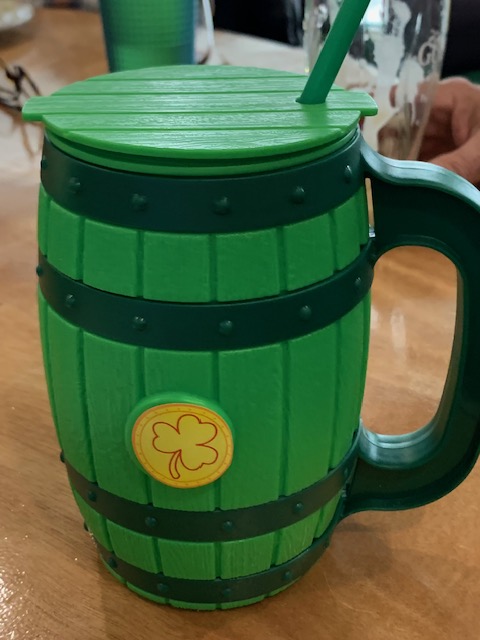
Many interesting and unusual activities take place every St Patrick’s Day. In locations all over the world, street traffic is usurped by parades, pubs are overwhelmed with people drinking green beer, the Chicago River is dyed green, and the Toronto Maple Leafs wear green shirts to play hockey. This man has influence, 16 centuries later!

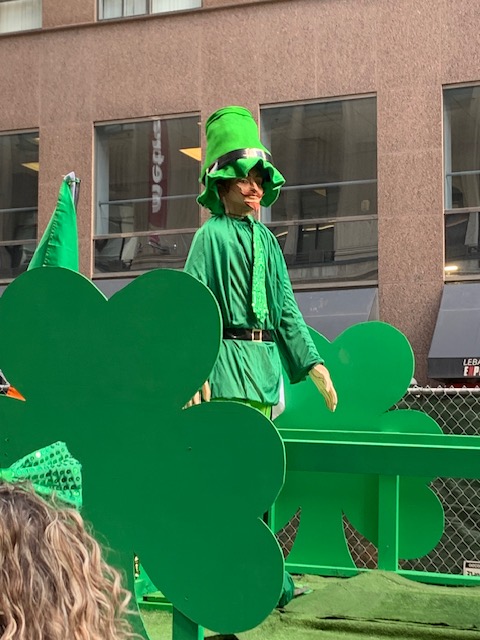
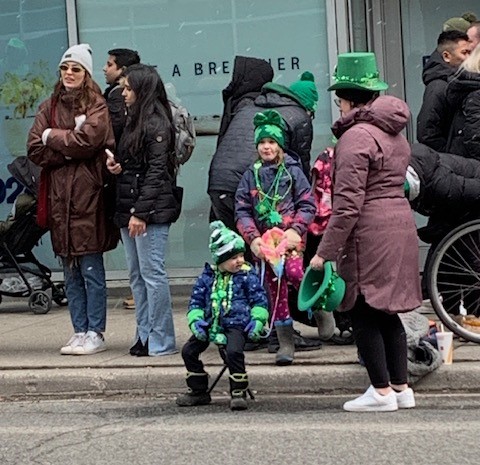
Torontonians really get into the St. Patrick’s Day spirit. It got me wondering: how many Irish people actually live here? According to census data, the Irish are the 4th greatest in number, around 10 % after the Chinese, English and Canadian. The biggest concentration is in the High Park area. A lot of them, wearing green, were at the St Patrick’s Day parade on Sunday.

Peter and I were heading downtown to see a Mirvish play on Sunday afternoon anyway, so we decided to crash this annual celebration. Sure enough, the first question we were asked by a parade watcher was: “So what county in Ireland are you from?” Oops.. we couldn’t even think of a name of a county to bluff with! Then we saw Olivia Chow in the parade. If she could pretend to be Irish, so could we.

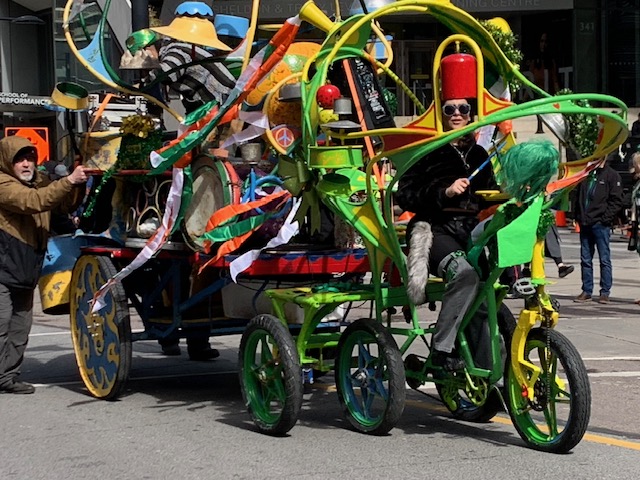
As we walked north along Yonge St, we saw lots of marching bands, rugby players, bicyclists hoisting balloons, a tiny boat from Niagara called Misty, a Batman car, a Chinese dragon, and even this contraption with no name:

The kids were having the best time. Several performers were children or teens. Small spectators were dressed up from head to toe as they sat on the curb and waved.

Some intriguing inclusions were bands, dancers, and floats from Scotland, which struck us as rare. When did these 2 countries, Scotland and Ireland, become such buddies? When had the United Kingdom become so united?

We looked around and realized that the parade also included cultural artifacts from Asia. There were marchers from workers’ unions across Ontario. And there were cheering crowds from all over the world. This was our multicultural city in action. On St. Patrick’s Day, we were ALL Irish.

Top o’ the mornin’ to ya!

Sue

Learning About KITE

No, this is not more “stuff” about Spring. This post is about a very different kind of experience we had last week. We tried to think of it as inspiring.

Peter and I joined a retired teachers’ group to visit a research hospital. It looks like a regular hospital on the outside: tall, boring brick, many many windows, and that antiseptic smell as we walk along the sterile corridors. But downstairs in the basement a whole new world exits, a world where innovation and technology create possibility. The KITE Institute.

We enter the first lab, a modern condo simulation, with additions. A robot companion greets us to ask how she can help. Monitors watch over us from the ceiling, ready to call for assistance if we fall. The bathroom has a toilet that tips forward to help us get up. The bed has grab bars which light up at night, on either side. One chair in the dining area is wired to collect health data: heart rate, blood pressure, and so on. We are constantly being watched. Could this possibly be a good thing?

Another lab is totally dedicated to falling. Volunteers are strapped into a harness as they stand on a floor which begins to tip and roll. A monitor checks for heart rate and involuntary movement as the “victim” tries to stay upright and balanced. Peter did this test once a couple of years ago, but he had played football in his youth and was trained in the art of not falling – feet spread apart, knees slightly bent, arms out. The research technician told him he was cheating!

As we age, the fear of falling is often with us. Another lab is used to study one paticular fall; the kind you have when you try to get out of the bathtub. Once again volunteers, wearing their harnesses, step from the bathtub to a platform, unaided by grab bars. The wired platform measures pressure and collects data about movement. Innovative products, like step-in tubs, are already on the market, based on this research.

The next lab is one you may have seen on CBC Marketplace, where testing of boot tread was the topic. The lab floor is a sheet of ice and the victims, once again strapped into a harness, test out various boot and shoe treads. The best treads are ones that have tiny bits of glass embedded into the sole. They sparkle in the sun and keep you upright on the ice.

The most interesting lab to me was the driver simulation lab. A full-sized car sits on a platform which can create unsafe driving conditions: speed, ice, obstacles, night driving, swerving, even fog. Not only can this lab evaluate driver performance, it can also help improve vehicle and road design.

This area of the hospital is called the KITE Institute (acronym for Knowledge, Innovation, Talent, Everywhere). The scientists are “dedicated to improving the lives of people living with the effects of disability, illness and aging.” The data collected is used to help with developing new devices and products. The institute also works to change public opinion and government policies.

One topic that grabbed my attention was based on the driver simulation lab. KITE has approached the provincial goverment with the idea of downgrading licences for seniors. Seniors with vision problems would downgrade to a driving licene that prohibits night time driving. When older folks begin having cognitive problems, their licence would prohibit highway driving, or permit local roads only. These accommodations would allow seniors to drive to the grocery store, the bank, medical appointments, and maybe bridge games at the local seniors’ centre. This way they (or we?) could stay in their homes and be more independent for longer.

Looking at these products and policy developments, and realizing that one day we may actually need some of them, was a little disheartening at first. On the other hand, isn’t it good to know that scientists are already engaged in trying to help us out?

Sue

Looking For Spring…

Even though it’s only early March, Mother Nature has been teasing us for quite a while, with signs of Spring. Peter and I went for a walk to the lake recently to take some photographs.

Along the streets, bushes are beginning to bud:

One hedge holds a bagel captive, maybe a make-shift squirrel feeder:

We passed a garden centre with an inviting sign:

One woman was industriously washing her car:

A few people, dressed warmly, walked along Humber Bridge:

One brave couple, covered in blankets, had a picnic in their inflatable boat:

When we got to the lake, the CN Tower was hidden in fog, but this swan came over to meet us:

The most enthusiastic critter looking for Spring was this racoon. The closer we got, the deeper he went:

Hope he finds it soon!

Sue

Winter Stations

Believe it or not, it is still winter. And last Friday Peter and I decided to explore one of Toronto’s fun winter venues. The Beach.

Ten years ago 3 Toronto design companies got together and decided it would be fun to find a winter use for the 6 life guard stations along Woodbine and Kew beaches. They offered the opportunity to the international arts community. There were a few rules: The design had to incorporate a life guard station but not be permanently affixed to it. The creator should assume there would be minimal security, and the possibility of damage from either weather or visitors. The use of fire or electricity (or swimming) would be prohibited.

In the first year, 2015, there were 200 submissions. Ten years later, 2024, there were over 400. This year’s theme is “resonance,” inviting the participants to use a design which resonates with winners from previous years. Kind of like plagiarism. The 6 winning designs are located near, or on, the life guard stations. Three other designs were chosen as runners-up and are installed along Queen St, creating a connection between the free beach displays and the local restaurants, ie No Free Lunch.

Some of the stations are built with children in mind. Making Waves, at the corner of Queen St and Kingston Road, has cranks for kids to turn, creating wave-like motions along the platform near the shore. Bobbin’ has a children’s teeter totter inside. We Caught a UFO! invites tiny tots to climb up to the top inside the UFO. Adhering to my philosophy of “live life to the fullest” I wanted to play on all 3 stations, but Peter said we had to keep going or we would be late for lunch. You can tell our priorities are different.

Two of the installations are meant to advertise climate change. Nova is a series of white tarps slung over the life guard station, with an opening at the top where the stars apparently shine through at night. The station is highly visible standing in the sand, kind of like somebody wearing a dress that is too short. Nimbus stands out, even from a distance. Blue ropes representing rain hang from bubbly white clouds. The viewer is asked to think about rain and what its absence means to the world. Peter and I were more inclined to think about the absence of snow.

One of the stations is a photographer’s dream. A human-sized Kaleidoscope challenges our perspectives through mirrors reflecting other mirrors and the lake. There’s a space between the 2 halves of the bright orange structure, where visitors feel like they have become part of the sculpture.

If you leave the beach and meander along Queen St. you’ll discover lots of quaint restaurants and bars to stop for a lunch break. You will also find 2 more enchanting sculptures. Delighthouse is a colourful and eye-catching lighthouse tower. And farther along you’ll run across a Toronto icon created from differently-textured plastics. Conrad, returning from 2023, is one BIG racoon!

During our very unusual February day, we wandered in the sand, we had a satisfying lunch in a tiny restaurant, and we walked about 15,000 steps. At the far end of the beach, near the RC Harris filtration plant, there was one final inviting scene – streetcars! We climbed aboard, and settled in for a nap on our way home.

Sue

The Luncheon

Last week about this time we were all making plans for Valentine’s Day: buying chocolates, sending flowers and entertaining. Me too. Except that my entertaining did’t go so well.

It was my turn to host a book club lunch. This is a new book club for me – I joined in the fall. So there was a bit of self-imposed pressure to make a good impression. I chose some parts of the meal from the book we were disucssing, and other parts to celebrate the occasion. I bought the ingredients and thought I was all set.

Wednesday morning before breakfast I began preparing. I decided to start with the cocktails so they’d have time to chill in the fridge. I was making Cosmopolitans, not because we live like characters from Sex In the City, but because the drinks are Valentine pink.

I filled a shaker with vodka, cointreau, cranberry juice, and lime juice, and shook them up. Then of course I had to taste them…ooh too bitter! So I added some more cranberry juice and tasted again. Nope – too bland. I added cointreau and tasted again. After some more tasting and adjusting I began to feel a little bit wobbly…not a good sign before breakfast! I quickly stuffed the cocktails in the fridge and started making the breakfast oatmail… I mean oatmeal.

After breakfast I worked on the Greek salad. I washed and chopped: romaine, onions, cucumbers, olives, feta. But still the bowl didn’t look very full. Something was missing. Aha… tomatoes! I had bought 2 ripe red tomatoes the day before, just for this salad. But Peter happens to love tomatoes so, to be on the safe side, I decided to hide them. But where??

I checked all the secret hiding places in the fridge. Then I looked through the kitchen drawers. And cupboards. Getting a little anxious, I headed to the basement pantry area where we keep extra food. Surely I had put them there. But no. In desperation, I started thinking about the Cosmopolitans in the fridge. Would just a little sip or two help me remember?

On my way to the fridge I spied our large ottoman in the sun room. It opens, and I have often hidden secret things in there. Like chocolate. And… tomatoes – there they were! I added them to the salad and organized the rest of the meal without any more issues. The cocktails were safe.

About noon the book club members began arriving. I ushered them into my newly-decorated sun room, through the dining room, so they wouldn’t have to navigate the little step from the kitchen. Everyone seemed to enjoy being together and we happily shared our news about health, family and travel plans. The main course was in the oven and the salad was in the fridge. All was going well.

Until one of the guests got up to find her purse, by way of the kitchen. In a nanosecond she tripped on the little step and went down onto the tile floor. She lay there, her nose bloody and her ankle turned in an odd direction. Her other friends got up to help her. They wiped her nose and helped her get up and hobble to the sofa.

Meanwhile I was in shock. Never mind the cocktail recipe or the lost tomatoes – how could my guest be lying on the floor? I couldn’t think of anything else to do, so I served lunch.

Things did turn out OK. The brave guest, whose nose dried up quite quickly, sat during lunch with her ankle elevated and ice on it. She even participated in the book discussion. Her husband brought her crutches from home when he picked her up. She recently reported that she has put the crutches away, but her ankle is brilliant in colours of purple and green.

As for me, so far I have not been demitted from the book club. I have not hidden any more tomatoes and I have not invited anybody else for lunch. And I did Not ask the injured guest if could take a picture of her colourful ankle, for my post. But I did make a temporary adjustment to the little step. It seems to be helping.

Hope your entertaining adventures go well.

Sue

The Sporting Life

On the weekend Peter and I, like many households, watched the Super Bowl game. We invited friends to join us, friends Peter has known for over 40 years. He has spent many special Sundays watching the Super Bowl with them.

Sporting events like this are held around the world. Who has not sat down occasionally to check out events at the Olympics televised from China, Vancouver, Paris, even Russia? Maybe you are a summer sports fan and enjoy watching swimming or track and field. Or you dream of mountains of snow and skiers racing up and over the moguls. Maybe you know a prticipant – like us, cheering for Rosie Maclennan a few years ago as she bounced and somersaulted and won gold for Canada, on the trampoline.

Some of these events take place right here in Toronto. Although we have to look pretty far back in history to find the Maple Leafs in any playoff activity, we remember a few other highlights. In the early 1970’s we cheered for the Blue Jays as they won the World Series 2 years in a row. And who will ever forget the Raptors and Kawai Leonard as they took us to the top of the NBA? Our city, in fact our entire country, was behind that Toronto team.

Our Super Bowl evenings with our friends are pretty traditional: our friends come before 6:00 pm to get settled and begin snacking on appetizers. The men discuss the upcoming game, and the women fill each other in on family news. During the game, everyone hopes for a glimpse of the million-dollar ads. Then it’s half-time and we watch the show while trying not to spill chili on our laps.

This year there were some extra highlights.The half-time show featured Usher, an R and B artist with a large back-up group. But the real celebrity was in the audience. Taylor Swift, in case you have been napping for the last several months, is the celebrity of the year, maybe even the decade. She has a lot of talent, writes and sings her own songs, and creates many of her own dance routines. Her shows are filled with movement, light and sparkle. Although the cameramen were told to focus on the game, they, (obviously “Swifties,”) couldn’t help sneaking glances at Taylor as she cheered for her boyfriend, number 87 on the field.

Our celebration was a little more low-key, with no celebrities. But we did have a couple of costumes to add to the excitement. You can see them in the photo:

And we had another highlight – betting. Peter created a pool where guests paid a toonie for each quarter of the game. Each person picked a small slip of paper on whch was written the name of one of the teams and a total score. At the end of each quarter, one better would win the entire pot – $12, minus the original bet of $2. Really only $10. Now we all know that $10 won’t even buy you a burger and fries at Harvey’s unless you have a coupon. But these betters went crazy, abandoning their drinks, eyes focused on the screen, even changing their original loyalties:

“Well I really want San Fransicso to win, but now Kansas City is worth $10 so Go Chiefs Go!!”

This group will be impossible to handle when the FIFA World Cup comes to Toronto for 6 games in 2026.

Sue

Canadian Chroma

Are the advantages of living in a big city worth the aggravations that sometimes happen? Last weekend we got to find out.

We took the subway to the Eaton Centre, the busiest shopping mall in all of Canada, with over 50 million visitors annually. Built in the 1970’s, it has been anchored by at least one major department store during most of its life. But that all changed when Nordstrom recently moved out.

The same thing has been happening to other malls across Canada and the US. Competition from Amazon and other online stores has drastically reduced in-person shopping. Sherway Gardens filled up vacated retail space with unique Christmas Markets. Another mall near us, Cloverdale, replaced a big Target store with – wait for it – pickleball courts! What would the Eaton Centre come up with to replace Nordstrom’s footprint? We read about it in the newspaper: Canadian Chroma.

Soon after we arrived at the Eaton Centre, the fire alarm began to beep at us. Shoppers stopped in their tracks, waiting patiently until we got the ‘all clear’ signal several minutes later. After lunch, Peter went to the washroom and came out reporting that a guy in one of the stalls was having a melt-down and the bathroom was full of security guards.

Finally we found our way safely to the new exhibit, a series of interactive displays highlighting the beautiful colours of our Canadian geography. The first stop shows dramatic photographs from coast to coast to coast: the majestic mountains of the north and west covered in sparkly snow, the golden wheat fields of Alberta and Saskatchewan ready for harvesting, the forests of Ontario dressed in autumn colours, the turqouise-blue waters of the maritime provinces. There are hundreds of photos in gorgeous hues; available by touching a colour and then a button.

Here’s one of the buttons between pink and coral:

The second stop in the display shows 4 photos of a log farmhouse from a nearby window, in all 4 seasons. The third stop depicts the Northern Lights in beautiful shades of green. The viewer stands on a set of footprints in front of the lights which respond to body movements with bubble columns and explosions.

Display number 4 promotes Indigenous art in a unique and fun way. There are 7 murals painted by 7 different artists, each divided into 7 panels. Viewers can mix and match the panels to create one entire mural by one artist or, if you have the patience, up to 49 different murals with 1 panel from each artist. It would be a good way to entertain grandchildren for quite a while.

(Here is your cheat sheet for the murals):

The final display is an interactive map showing where we Canadians originally came from. Virtual threads in different colours link places in Canada to other places around the world. For example, Peter found a fuscia thread connecting Toronto to Italy. He was so pleased to see his journey on display. All in all, Canadian Chroma was well worth a visit. And it was free!

Then we headed for home.

When we got to our subway station, the line was closed to sort out a security issue. We decided to walk south to Queen, and take a streetcar west to the University line. At Queen we discoveed that the streetcars were not running due to construction. So we had to walk to King, and then along King to the next streetcar stop. Finally we found a streetcar, and another subway, and then home.

Were the security issues, the costruction, and the subway delays stressful? Well they did slow us down. But heck, we are retired – we have the time. That seems a small price to pay for experiencing life in a big city.

Sue

PS Since our winter in Toronto seems to have passed with barely a dusting of snow so far, I thought you’d like to see this photo from the exhibit:

A Grand Sausage

High Park Club, where we curl on Friday nights, owes its existence to the Scottish game. Last Friday, when we visited, we took part in another Scottish tradition; Address To the Haggis.

The reading of this poem, by the famous Scottish poet, Robbie Burns, is the cornerstone of the celebration of Burns’ birthday, January 25, 1759. Burns was the son of tenant farmers and grew up living with poverty, hardship and manual labour. He had no formal schooling, but he taught himself the English language, well actually, the Scottish dialect. And the result was lyrics that are fondly remembered over 250 years later.

Many of us sang one of his best-known pieces, Auld Lang Syne, on New Year’s Eve. As young children, we may have heard parts of his Ode To A Mouse, a tribute to the small animals sharing his farmland.

The writing we recall on Burns’ birthday is his dedication to the haggis, intended to be read by someone, preferably of Scottish descent, as he or she escorts the mighty sausage to the buffet table. A bagpiper leads the procession:

“Good luck to you and your honest plump face, Great Chieftan of the sausage race!

Above them all you take your place. Well are you worthy of a grace!”*

*Then a wee dram of fine Scotch is used to toast the haggis.

The poem goes on to name the ingredients of the haggis, which might put you off your breakfast, so I’ll just say that they are chopped up and mixed with onions and spices, the more the better, and then stutffed inside the casing of a sheep’s stomach. Food was scarce in Burns’ life and no part of the animal was wasted. The haggis is often served with potatoes, turnips and cabbage, which help to mellow the taste. It is all very filling.

Besides his stomach, Burns filled his life with food for his brain. He wrote songs, learned some French and Latin, and eventually published a volume of poetry that was admired by farmers and literary critics alike. He worked hard to acquire the nuances of poetry writing. During his short life, (he died at age 37), he wrote so much popular verse that he was considered the patron poet of Scotland.

Burns also socialized a lot. He had numerous friends who met at local pubs and sang together. And he had a lot of female relationships including 3 marriages and several affairs. The result was 12 children. Burns’ biographers estimate that he has about 900 living relatives in the 21st. century. He certainly put that sausage, I mean haggis, to good use.

Sources say that Burns’ most famous living relative is Tommy Hilfiger. Tommy is the great, great, great nephew of the poet. Apparently Tommy does not publicize this kinship. In addition, there are monuments to Burns around the world. The closest one, should you wish to visit, is in Allen gardens in downtown Toronto. And you can find a haggis recipe online.

Sue

Monument in Toronto

Waiting In Line

As Seniors living in the city, we feel the days slipping by fast. One day it’s Tuesday and I am writing to you, and then it’s Tuesday again! What happened to those days in between? Time seems to fly by.

Which is why waiting in line is such an aggravation. It seems there are lines everywhere we need to go: the drug store, the blood clinic, the LCBO. Sometimes waiting in line can be worth it, especially when the end product is fun. In the winter those of us who are able, wait happily in line for the ski lift that will take us to the top of the hill, and the glorious run down to the chalet. In the summer we wait patiently with our grand kids for a ride on a roller coaster or an ice cream cone.

But there are lots of times when waiting in line is just a waste of our precious time. We line up to buy last-minute concert tickets and then get to the box office, only to be told that the concert is sold out. We are on a subway train which breaks down, so we line up for a shuttle bus and therefore miss an enjoyable lunch with friends. We get in line at the airport baggage carousel to pick up our suitcases after a long flight, and then…our luggage is not there!

I see these kinds of stressful line-ups at the food bank where I work. The unfortunate folks who have to visit are embarrassed at their need for this service. They come dressed in the warmest clothes they have, often missing hats or gloves and wearing shoes instead of boots. Then, because of lingering Covid germs, the line is spread out, leaving some outside shivering as they wait for their turn.

And I haven’t even begun to talk about waiting in line on the phone, twiddling our fingers as we hear over and over and over: “Your call is important to us. Someone will be with you soon.” HA!

The other day I decided to protest. I was second in line at the bank, where there was only one teller and he was dealing with a woman who had a file folder almost 3 cm’s thick. It must have been some major business transaction because she was slowly going through each page of this folder, one by one.

In line ahead of me was an elderly gentleman. We began to pass the time in conversation. He said he had been waiting almost 15 minutes already, but he didn’t mind because he was retired, lived alone, and enjoyed getting out and meeting people. Then he told me his age – 95. I was shocked. Why should a 95-year-old man have to stand up that long just to get some money that was probably already his?

I hurried over to a side wall and grabbed an empty chair. I hauled it, and then another one, into the line. I motioned for him to sit down and I took the chair behind him. When the next customer arrived, I advised him, in a loud voice, to get a chair too because the wait was really long.

Suddenly, out of nowhere, a second teller appeared and unlocked her computer screen. She welcomed the elderly man with a smile. I felt somewhat vindicated.

Next time you have to go somewhere that has a line-up, maybe take along a folding chair and a book. Even as Seniors we can still make a statement.

Sue

Well maybe this is a slight exaggeration…

Heliconian

Come on, admit it. You remember Yorkville during the 1960’s too! We were either in university or checking out the job market. On Friday nights we went to Yorkville to see Gordon Lightfoot, or Joni Mitchell, or even Neil Young at the Riverboat or one of the other clubs or coffee shops that popped up during that intoxicating decade. After that we moved on to building careers and raising children, while Yorkvillke went downhill when biker gangs and drug dealers moved in.

Soon the new Bloor-Danforth subway line enticed high-end businesss, and a new class of patrons, rich shoppers, started coming by. That area is now referred to as the “mink mile.” Stores like Versace, Louis Vutton and Cartier sell exclusive items, and restaurants serve the latest in food trends, with a negroni cocktail, and a serving of kale on the side.

Through all of this a lot of renovation and rebuilding has taken place. But there are still a few old gems hanging around. The Yorkville Library at 229 Yorkville Ave is one of the earliest branches of the city library system, designed in 1929 in the Carnegie architectural style. The first site of Mount Sinai Hospital, built in 1923 at 100 Yorkville Ave, is now a trendy store.

My favourite old building is the Heliconian Hall at 35 Hazleton Ave. Originally a Baptist Church built in 1875, it was bought by a feisty group of women who had founded an arts group in 1909 and were loking for a permanent home. The building, designed in a style referred to as Carpenter Gothic, ie Gothic in wood, is the oldest building standing in Yorkville.

Inside the building that feisty group of women, or nowadays their grand daughters, still run an active arts program open to the public. The name comes from Mount Heliconian in Greece, said to be a source of poetic inspiration for the muses. There are concerts, performances, and art shows on a regular basis. And the best known? A literary lecture series once a month. The club invites Canadian authors with recently-published books to come and speak to an audience of about 150. There are rarely any empty seats.

I have seen many reputable authors there. Marie Henein comes to mind. She was the laywer for that controversial case involving Jian Ghomeshi a few years ago. I expectd her to be another feisty woman. And she was! I also heard Ann-Marie MacDonald and Wayne Johnston, 2 Canadian authors whose fame is well-known, even in the US. Later this season we are being treated to a lecture by Dr. Vincent Lam who now spends a lot of his spare time writing. His latest novel takes place in a Toronto ravine and deals with a timely subject – drug overdosing.

I attend these presentations with an old friend who shares my love of writing. On our subway trips we discuss our latest novels, stories and yes, even blog posts! When the subway arives at our stop, we have a short walk through Yorkville, beautifully lit up at night, until we arrive at Heliconain Hall. We share tea and cookies with other members of the audience. Then we all settle in for the lecture and audience questions.

What better way to spend a winter evening? Friendship, food and our favourite Canadian writers, in an historic setting.

Sue