Many of us take flying for granted. Go to the airport and climb aboard. But it wasn’t always so.
In the early 1930’s, less that 100 years ago, there were no airports in Toronto. The 2 facilities were built almost simultaneously at the end of the 30’s: an airport on Toronto Island and another one in a field to the north. Billy Bishop on the island, which opened in 1937, got first choice of codes and became YTZ, while Malton/Pearson had to settle for YYZ. Both airports have evolved to serve different purposes in the city.
Billy Bishop welcomed its first incoming flight in 1939. Tommy Dorsey and his swing band flew in from New York City to great fanfare. King George VI attended the opening ceremonies. After that the airport was utilized for WWI training exercises by forces from Norway. When the soldiers and their planes returned home, they left behind a memorial stone on a plot of land that is now known as Little Norway Park.

After the Norwegian troops left, Canadian forces took over the airport in 1942. This is where flying ace Billy Bishop called home. Here he met William Barker and the 2 men became close friends, flying and fighting in WWI and most of WWII.
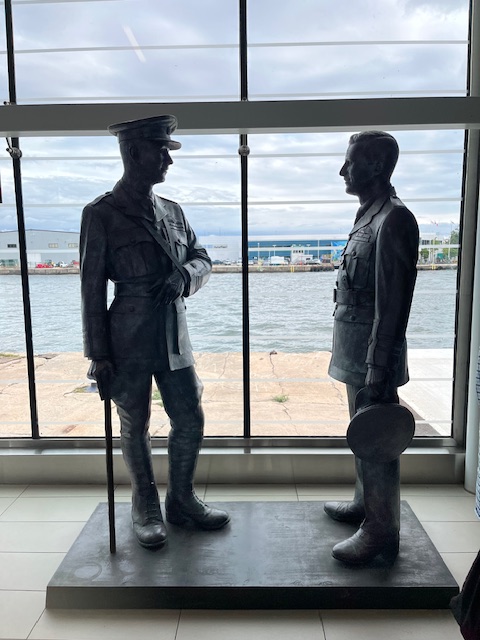
Billy Bishop on the right
The airport went through many iterations during those early years: civil flights, regional airlines, even ORNGE Air helicopters used for medical support. Then in 2006 Porter Airlines became the main tenant and the airport flourished. In 2015 a 250-foot underwater tunnel was constructed, making pedestrian travel from the mainland quite simple. As the airport capacity and convenience grew, Air Canada began to utilize this facility too.
Peter and I joined a Heritage Tour last weekend to get a closer glimpse of the airport. On our walk from Little Norway Park to the terminal, we passed the creation of a colourful wedding photography spot. Then we walked by a park where statues honour the Irish Immigrants who came to Canada to escape the potato famine. It was a heartbreaking contrast of happiness and despair.


Finally we approached the terminal, situated on the Island. But how to get there? First we rode elevators down to the lower level. Next we we took a moving sidewalk through the tunnel under Lake Ontario to the island. Occasionally we looked up, checking for leaks. Then we got on the escalator, apparently the highest one in the world, over 100 feet up. Unfortunately, the escalator went on strike when we were half-way up and we had to walk the rest of the way.
Dear readers I gave up on you at that point. I had to sit down to catch my breath. But Peter carried on and said the view up there on the island looking back towards the mainland was a perfect way to observe this unique achievement from above. Go and see for yourself.
Sue
 Seventy In the City