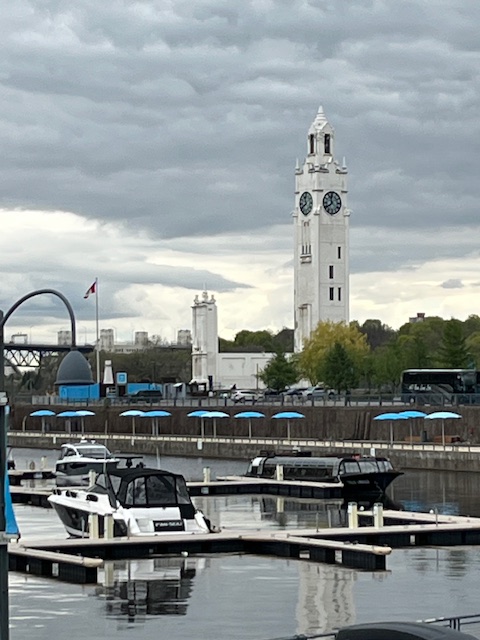
Old Montreal

The Old Port

Being true to our “Buy Canadian” values, Peter and I chose Montreal as a short vacation destination. We were once again reminded of the ease of travel within Canada: no passports or customs hassles, no currency exchange, no health care worries, and no language problems. I even tried out my basic French occasionally and was rewarded with a smile. Or was it a smirk?

The last time either of us had visited Montreal was over 50 years ago. Peter visited expo in 1967 and I went to a conference in 1972. Would the city have changed since then? My recollections were of a hangover from too much free wine on the plane, and expensive shopping on St Catherine Street. Peter remembered sharing a room in a high-end hotel with about 4 other young guys. Several decades later, we were going with another older couple like us, and we needed a different plan.

We were told to be sure to stay in Old Montreal, near the Port and the waterfront. It sounded perfect – old and quiet. We found a perfect hotel too: L’Hotel near the port, with lots of eateries, and a subway stop. The hotel itself had large comfy beds, a convenient breakfast area, and art on all the walls in case we woke up with insomnia in the night and needed to go for a stroll.
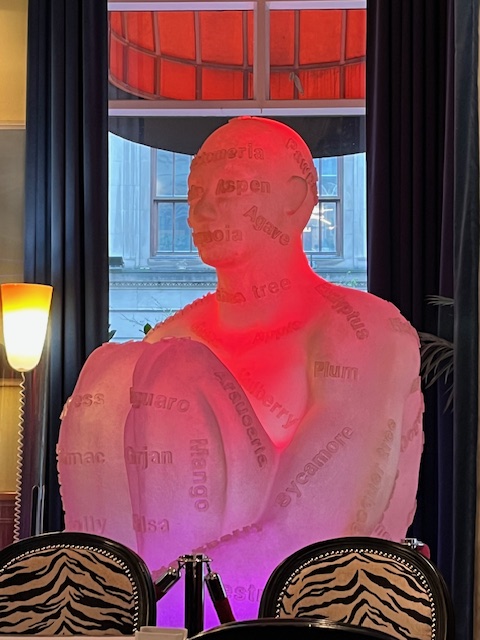
Art in the hotel lobby

We spent the first day wandering around the waterfront and enjoying the architecture. It was a big contrast to Toronto, where old buildings have mostly been torn down and replaced with steel and glass skyscrapers. Here the buildings have been re-purposed: into restaurants, boutiques and markets. The 1864 Royal Bank, once the tallest building in the British Empire, has been transformed into office space, where the ground floor is now the Crew Collective Cafe- a place for small businesses to rent internet service and hold informal meetings.
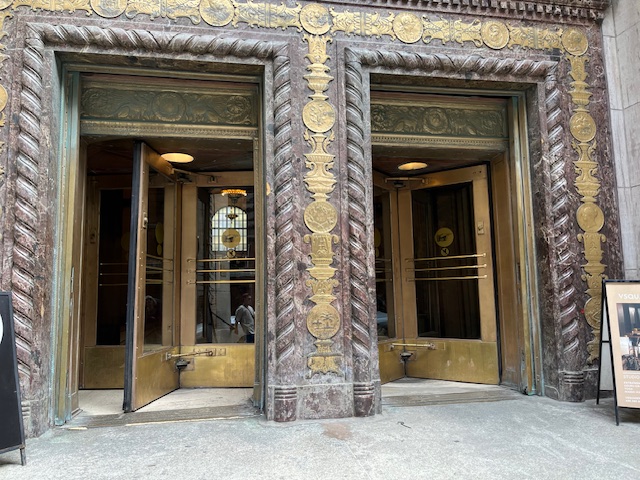
Front doors of Royal Bank building

We limited ourselves to One church only – Mary Queen of the World 1894. We chose this one because the front piece of the altar, officially named the ciborium, was built in 1900, and is an exact copy of the ciborium in St. Peter’s Basilica in Rome where the new Catholic Pope recently held his first mass.

Pope’s altar

On our wanderings we ran across this monument to Sir John A Macdonald, missing John, who was first painted red, and then torn down by protesters in 2020 because of his support for residential schools. (He is now residing somewhere else). Then we wandered through Hudson’s Bay, another sad ending for an historic building. We couldn’t even find any souvenirs to buy.
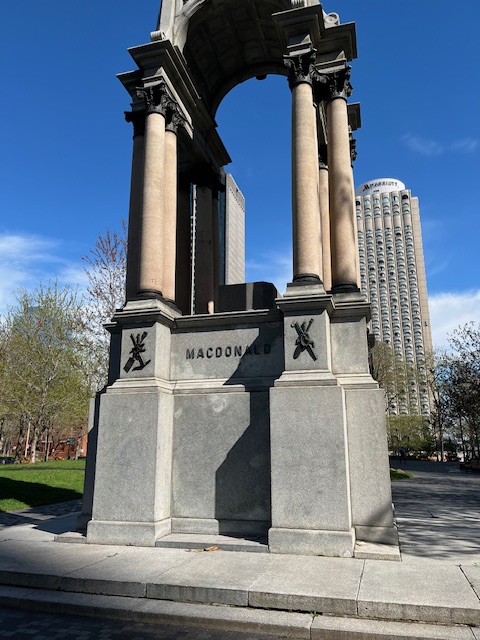
Where is John?

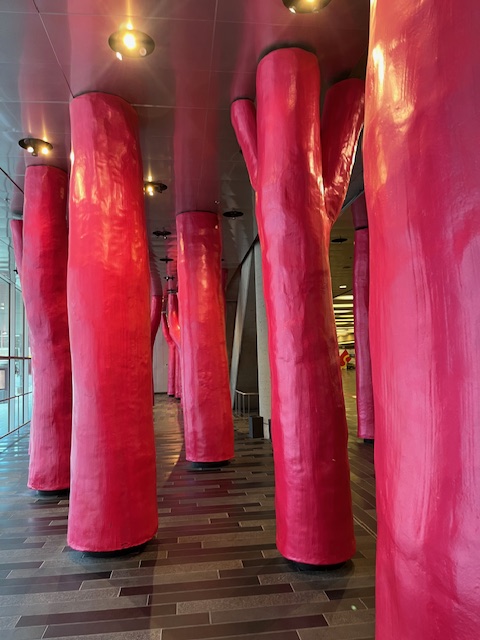
One of my reasons for wanting to visit Montreal was to see some installations by landscape architect Claude Cormier, famous for Sugar Beach, Berczy Park and Love Park, in Toronto. We saw 4 in his home town of Montreal. The grounds of the Clock tower at the Old Port are enhanced with a creation similar to our Sugar Beach. Dorchester Square has been reconfigured with bridges, benches and a fountain. The Ring separates 2 office buildings in Place Ville Marie. The most unique installation stands in the lobby of the Palais des Congress, a convention centre, where live trees and bushes are replaced by The Lipstick Forest.
We wound up each day with dinner close to our hotel. Our travels, mostly on foot, had worn us out and we didn’t want to miss our bedtime! So we chose: Brew Pub, Mexican, and Asian, with a glass of wine or a beer to start. And for those of you who are wondering about where was the French food? We did have one French lunch, all cheesy and delicious, on a patio near the port.

This, and other minor adjustments, meant that travelling for older folks is not only possible – it’s FUN!.

Sue
Canadian Chroma

Are the advantages of living in a big city worth the aggravations that sometimes happen? Last weekend we got to find out.

We took the subway to the Eaton Centre, the busiest shopping mall in all of Canada, with over 50 million visitors annually. Built in the 1970’s, it has been anchored by at least one major department store during most of its life. But that all changed when Nordstrom recently moved out.

The same thing has been happening to other malls across Canada and the US. Competition from Amazon and other online stores has drastically reduced in-person shopping. Sherway Gardens filled up vacated retail space with unique Christmas Markets. Another mall near us, Cloverdale, replaced a big Target store with – wait for it – pickleball courts! What would the Eaton Centre come up with to replace Nordstrom’s footprint? We read about it in the newspaper: Canadian Chroma.

Soon after we arrived at the Eaton Centre, the fire alarm began to beep at us. Shoppers stopped in their tracks, waiting patiently until we got the ‘all clear’ signal several minutes later. After lunch, Peter went to the washroom and came out reporting that a guy in one of the stalls was having a melt-down and the bathroom was full of security guards.

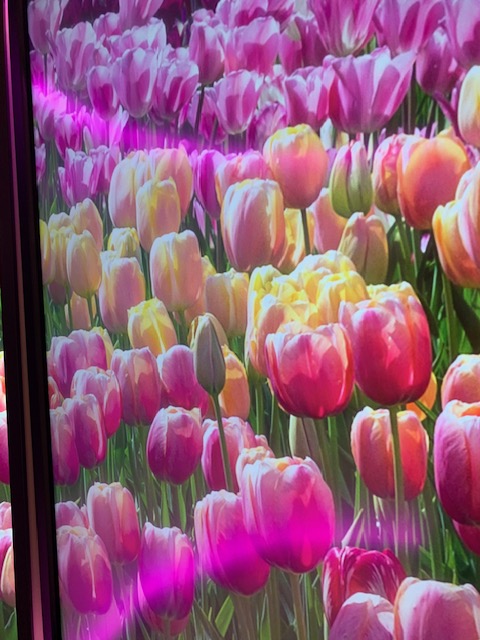
Finally we found our way safely to the new exhibit, a series of interactive displays highlighting the beautiful colours of our Canadian geography. The first stop shows dramatic photographs from coast to coast to coast: the majestic mountains of the north and west covered in sparkly snow, the golden wheat fields of Alberta and Saskatchewan ready for harvesting, the forests of Ontario dressed in autumn colours, the turqouise-blue waters of the maritime provinces. There are hundreds of photos in gorgeous hues; available by touching a colour and then a button.

Here’s one of the buttons between pink and coral:

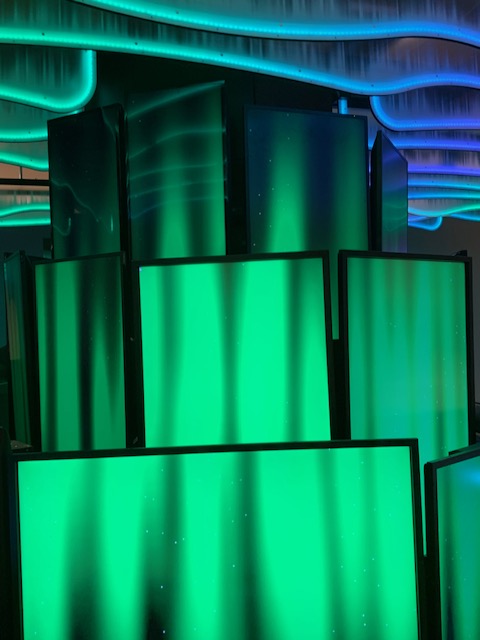
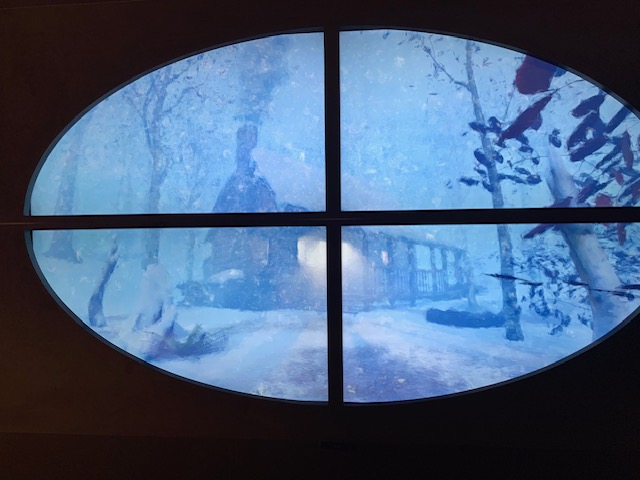
The second stop in the display shows 4 photos of a log farmhouse from a nearby window, in all 4 seasons. The third stop depicts the Northern Lights in beautiful shades of green. The viewer stands on a set of footprints in front of the lights which respond to body movements with bubble columns and explosions.

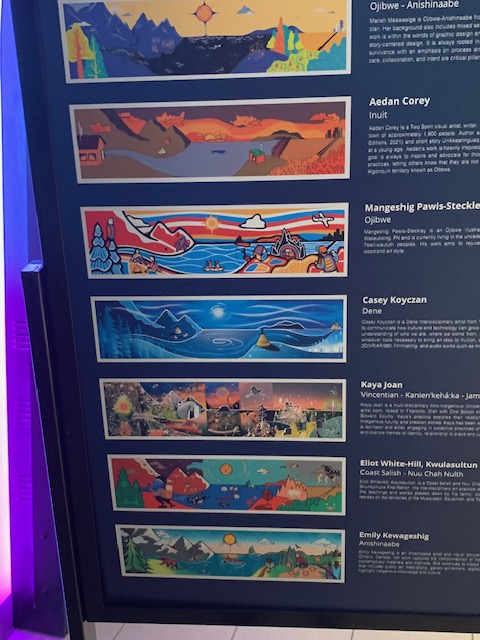
Display number 4 promotes Indigenous art in a unique and fun way. There are 7 murals painted by 7 different artists, each divided into 7 panels. Viewers can mix and match the panels to create one entire mural by one artist or, if you have the patience, up to 49 different murals with 1 panel from each artist. It would be a good way to entertain grandchildren for quite a while.

(Here is your cheat sheet for the murals):

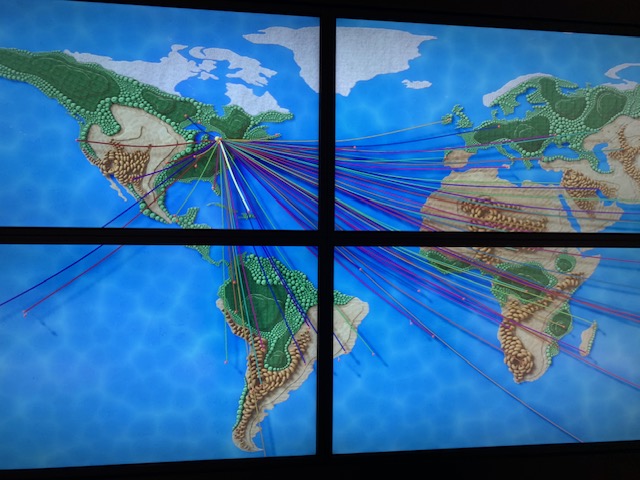
The final display is an interactive map showing where we Canadians originally came from. Virtual threads in different colours link places in Canada to other places around the world. For example, Peter found a fuscia thread connecting Toronto to Italy. He was so pleased to see his journey on display. All in all, Canadian Chroma was well worth a visit. And it was free!

Then we headed for home.

When we got to our subway station, the line was closed to sort out a security issue. We decided to walk south to Queen, and take a streetcar west to the University line. At Queen we discoveed that the streetcars were not running due to construction. So we had to walk to King, and then along King to the next streetcar stop. Finally we found a streetcar, and another subway, and then home.

Were the security issues, the costruction, and the subway delays stressful? Well they did slow us down. But heck, we are retired – we have the time. That seems a small price to pay for experiencing life in a big city.

Sue

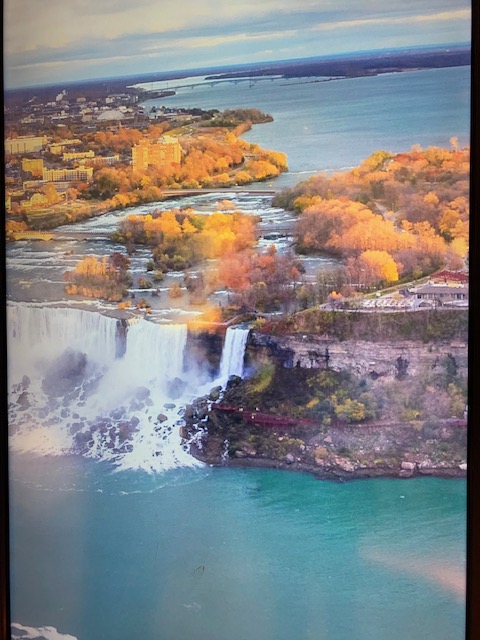
PS Since our winter in Toronto seems to have passed with barely a dusting of snow so far, I thought you’d like to see this photo from the exhibit: