
Last weekend Peter and I went looking for a cemetery. “Now why would we do that?” you ask. Was I so desperate for material?
The truth is that a friend and I belong to a book club where the author speaks to us in person, and we always feel obligated to read the book. Plus they serve cookies and tea before the meeting. The title for November caught my attention: The Knowing; A History of Canada Through the Indigenous Lens. What was a “knowing” anyway?
The author, Tanya Talaga, explains early in the book about what a “knowing” is. In a nutshell it’s a body of thoughts or facts that everyone knows to be true, but is not documented or published. I guess, for example, that all adults know that they themselves play the role of Santa at Christmas. But they would never disclose this secret because it would break the hearts of many little children.
In the Indigenous culture there is no Santa. But the people have known for years that their children were stolen from them and often died as a result of their lives in residential schools. It was a well-hidden “knowing” until 215 when remains were found on the grounds of the Kamloops residential school. The Canadian government kept it a secret because of their involvement, and the indigenous people didn’t discuss it openly because that would confirm their sad reality.
But ground-penetrating radar equipment uncovered the truth. Stories emerged of staff abusing children, sending them fishing in unsafe canoes and allowing them to drown, giving them polluted water to bathe in and even drink. School officials filled the schools to overflowing so they could collect the $4 annuity the children received. Medical care was non-existent and a lot of the students died of tuberculosis in the damp cold buildings.
As Talaga learned about this terrible truth, she wondered about her own family and began to trace her ancestors back to the 1800’s. One person eluded her: Annie, her great grandmother. Talaga discovered that Annie married twice and had 7 children, five of them “lost.” But after Annie reached the age of 60, she seemed to disappear. Was she one of the bodies buried somewhere in an unmarked grave?
Talaga’s research was meticulous and widespread. She travelled from James Bay where Annie was born in 1871 all the way to Saskatchewan where Annie lived with her second husband. Talaga visited libraries and document centres, and she searched out contacts. She read and re-read the Indian Act of 1887 and many other treaties and agreements. She even found data that had been collected by official inspectors and then discarded. All her work led her to Annie and her life until she was about 60. Then she seemed to disappear. Where had she gone?
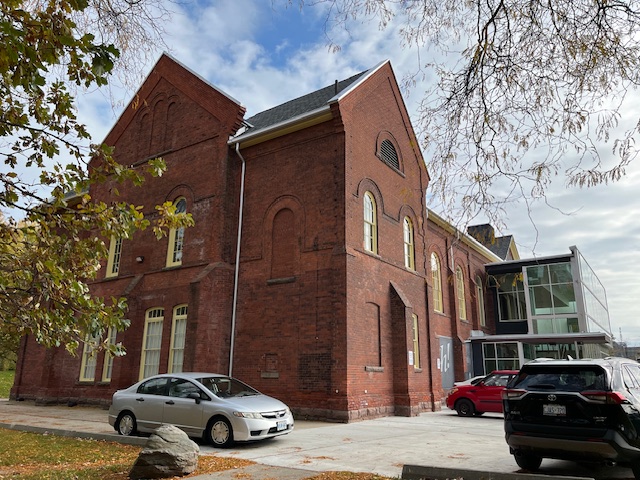
Through a contact, Talaga had a lucky break. She was able to follow Annie’s trail to the Lakeshore Lunatic Asylum in Etobicoke, where older Indigenous people without family support were placed. (The building was later re-named the Lakeshore Psychiatric Hospital). Many residents died there from disease and old age and the hospital needed a place to put their bodies. They took over some vacant land, about 3 kilometers away from prying eyes. The patients themselves cleared the land and dug the graves. Annie was buried there in 1937.
Ninety years later I found out about Annie’s grave in our neighbourhood, and coerced Peter into making a visit to find Annie again. We know the former hospital. It has been bought by Humber College and sits on the Lakeshore campus, serving as an assembly hall. Several movies have been filmed there including Richard Burton in Equus, and the Police Academy series.
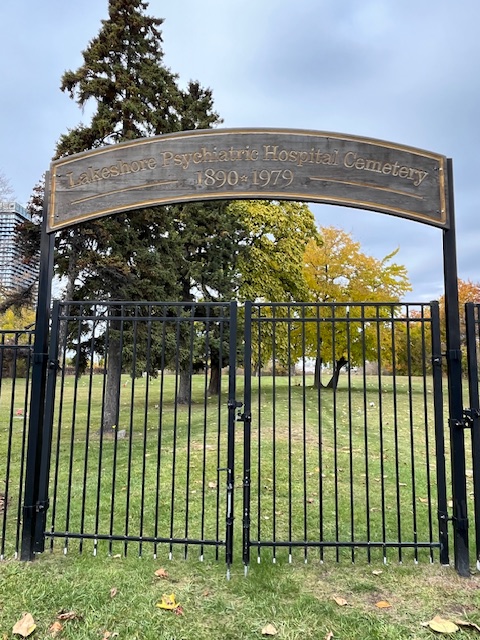
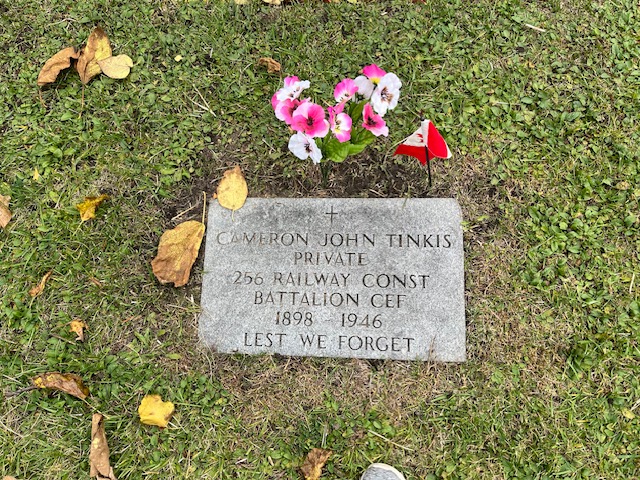
The cemetery, which is located at the corner of Evans and Horner Aves, has been resurrected by volunteers and local councillors. More than 1500 graves are now numbered so that visitors can find loved ones. On Remembrance Day it is fitting to mention that 24 of them are WWI veterans and those graves have names and Canadian flags. It’s a quiet place where Annie and others have found peace at last.
The Indigenous “knowing” is now ours too – just a few kilometers from our doorstep.
Sue



 Seventy In the City