To the Moon.. And Back!

My post on March 31, about the astronauts and their recent trip to the moon, received a lot of feedback.

Several readers brought it up at restaurants, on the phone, and by email. The subject even caused a major discussion, with a few raised voices, at Easter Dinner. The arguments for and against are based on feasibility. Those of us in love with the moon argued on the side of hope. Just think of the idea of a new start for humanity! No more climate disaster. No more wars. No more autocrats!

The naysayers felt differently: How could one even begin to build a livable settlement there without vegetation, water and especially AIR? The costs would be astronomical ( forgive the pun). And as for money, what about all the starving people in Gaza? Or homeless people in our own country, never mind Ukraine and Lebanon? And this doesn’t even account for all the money foolishly wasted on weapons of war.

One devoted reader of my posts usually sends very positive comments. Not this time. She began with “Please forgive me.” oh oh. Then she went on to say that it is “a childish fantasy to consider relocating our civilization to another planet” when we can Barely manage this one. That last part is certainly true!

A few days later she sent me some music, a Bette Midler song you probably know: “From a distance the world looks blue and green …there is harmony and it echoes through the land… the voice of hope… the voice of peace…. the voice of every man…” Jeremy Hansen would probably agree.

Then, after more thought, this same reader sent me a song by Ernie of Sesame Street fame. An adorable little video of Ernie the philosopher goes like this:
“Oh I’d like to visit the moon, but I don’t think I’d like to live there. I’d like to look down on the earth from above, but I’d miss all the places and people I love.” It’s a Youtube video and worth playing to your grandkids. Thank you so much Dorita.
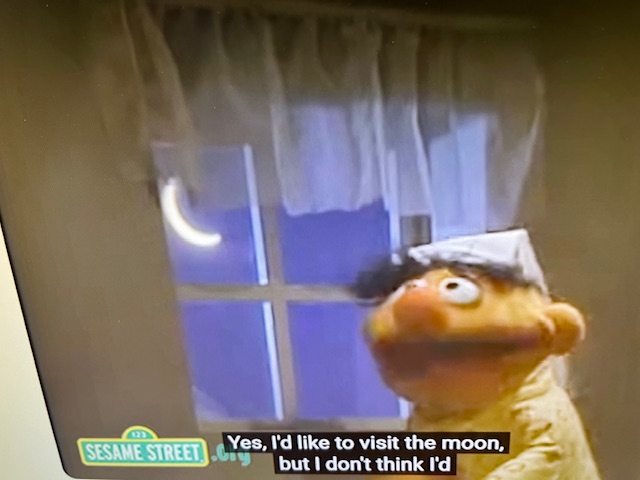
Check it out on the Youtube channel

Meanwhile, back at home: the astronauts landed safely. All four emerged from their capsule into the bright sunshine, no doubt grateful for the ride, but happy to be home again. Their trip produced an incredible amount of data: using new technology to photograph the moon’s surface, checking out new communication tools, trying out the spacecraft’s design for living in a confined area with other people for an extended period of time.

And they came home in time to welcome Spring.

Yes! Spring IS here! The dirty piles of brown slush have finally melted. The snow tires are put away. The Blue Jays have begun their season. Our double duty oleander bush has been moved, from inside where it sits at Christmas festooned with lights, to the back yard patio where it blooms in bright red flowers all summer.

The first robin, plump with possibility, visited our driveway:
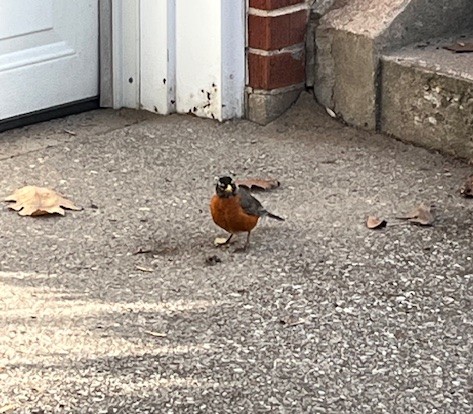
Actually, I would really miss the changing seasons on the moon.

Sue
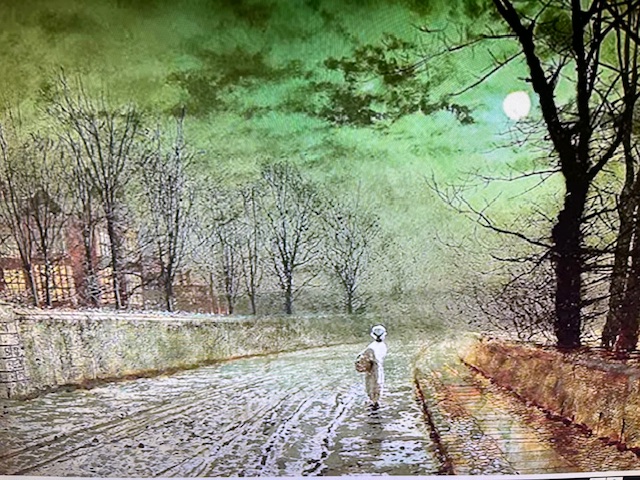
The Moon

Our Canadian culture embraces the moon. Think of all the songs that you know, that you are humming right now, about the moon. Think of the very first book you read, Good Night Moon, or the very first nursery rhyme: “The cow jumped over the moon,” the first love song you shared with your partner, Moon River, moon phases in indigenous culture, moon cakes from Japan, and moon boots. The moon cycles, new moon, full moon, are sources of inspiration for planting, harvesting, predicting weather patterns, and planning for babies. How many people, since time began, have stared up at the moon and wondered what it would be like to live there?

Since the 1700’s we, the people of the earth, have been trying to find out. Early studies of space shows that the first telescopic discovery of a planet, Uranus, was by a British guy, William Herschel, in 1781. The first mammals to survive a space flight were a pair of dogs, sent into orbit by the USSR in 1951. The first photograph of earth from orbit was by the USA in 1959.

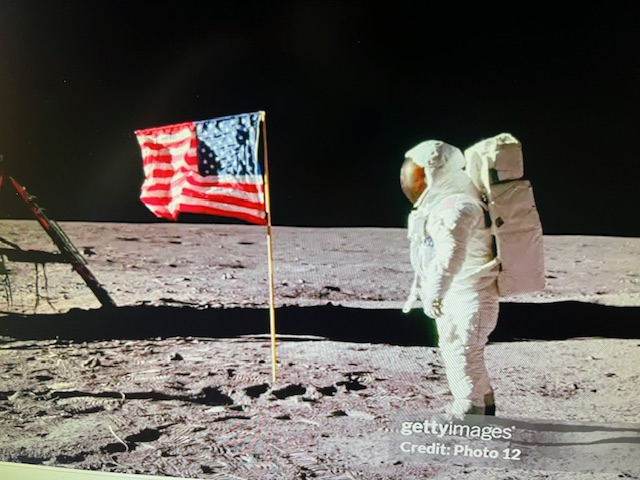
Then things sped up and in 1961 both Yuri Gagarin USSR, and then Alan Sheppard USA, piloted space ships in orbit. During the 1960’s the USSR and the USA took turns achieving space goals. The USSR sent the first woman into space, and made the first soft landing on the moon. Then came that famous day that we all remember: July, 1969. Neil Armstrong spoke for all of us: One small step for a man, one giant leap for mankind. Then he and his crew returned safely to earth.

Things in space seemed to grow quiet for a while. But while astronauts were taking a rest from space flight, experiments were going on. The first lunar rovers travelled around the moon’s surface, and the first space station was developed by the USSR. There were a number of attempts to study Mars, from orbit or on soft landing vehicles. There were flybys of Mercury and Jupiter, Venus and Saturn. Data was being gathered and studied.

In the 1980’s more attention was paid to astronauts in space. Several had long research stays on the space station, and returned safely. And in 1998 the first international space station was built and then assembled in space. In 2015 the first food, lettuce, was grown and eaten on the space station. This was a big step towards self-staining life in space.

Space travel hasn’t always been safe. Almost 200 astronauts have been killed due to space-related accidents. In 1967 3 US astronauts died during a pre-test. In 1986 the space shuttle Challenger heading to the International Space station, broke apart just after launch. It killed all 7 astronauts on board and was witnessed by millions of people on TV. Then in 2003 another shuttle, the Columbia, disintegrated during re-entry killing all 7 astronauts, and once again stunning TV audiences.

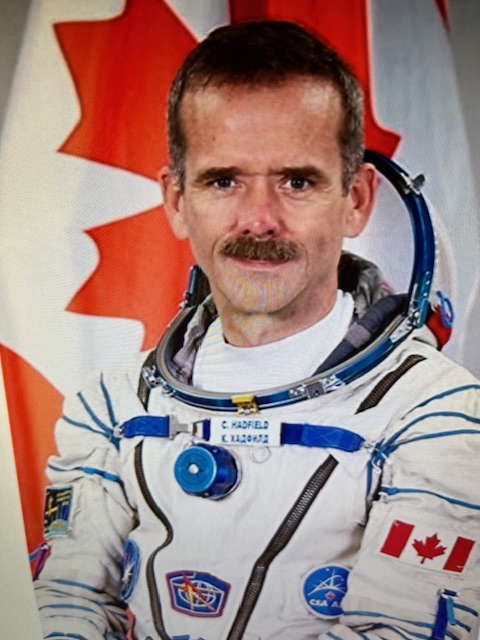
Nevertheless the excitement of space exploration still lures us. Once again it is the moon calling. And Canada is sending our 9th astronaut along for the ride. Marc Garneau was our first astronaut and he flew on 3 missions to a space station in the early 2000’s. The most famous so far is probably Christ Hadfield, who has served on several space missions including as the commander on the ISS (International Space Station). He is also well known for his social media presence and his books.

Tomorrow, if things go as planned, Jeremy Hansen will take his place among our Canadian heroes as he travels, with 3 other astronauts, on a new path – around the moon and back. Few people have seen the “dark side of the moon” and there will be opportunity for lots of tests, especially ones that will confirm whether the moon’s surface can support human life for an extended time. The next stop – Mars!

These days with our planet in turmoil, it’s comforting to think that maybe, just maybe, a future generation can escape to a new world where civilization can begin again. And do things right.

Sue