Univer-city

Many Canadians, who live somewhere other than Toronto, sometimes refer to our great city as the “Centre Of the Universe.” And not in a nice way! But the other day, as Peter and I had a chance to wander down University Ave, we both felt proud.

We started our journey along Hospital Row which is itself a cause for pride. There we passed Sick Kids’ Hospital, and Princess Margaret Hospital, both of which are known world-wide for their specialties. Then we came to Toronto General Hospital which has been chosen as the 2nd best hospital in the entire world. Pretty good, I’d say from personal experience, as I pat my new pacemaker!

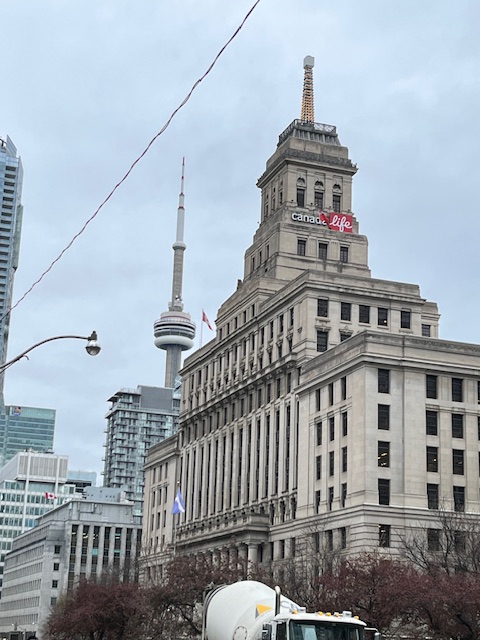
Farther down on the right is the Canada Life Building, built in 1931 in the Beaux Arts style. It is particularly well-known for having the oldest weather beacon in Canada on top. The signals are clear: red for cloudy, flashing red for rain, white for snow, and green for sunny. Lights flashing up mean temperature going up, and flashing down means the opposite. The weather “report” is updated every 6 hours, but mostly this winter it has been white! Apparently the interior is magnificently adorned with gold leaf and marble, but we were on the other side of the street and had more things to see.

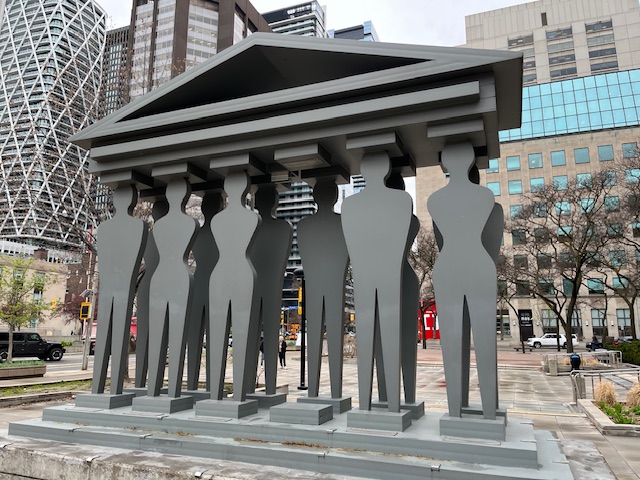
Back on the left side of the street are the McMurtry Gardens of Justice, enhancing the Superior Court of Justice building. In the gardens’ centre stands a provocative statue called the Pillars Of Justice by Edwina Sandys, 2007. The sculpture denotes the 12 jurors in our justice system, except – one of the jurors is missing. That spot is reserved for us, the ordinary citizens who are called upon to be part of our legal system.

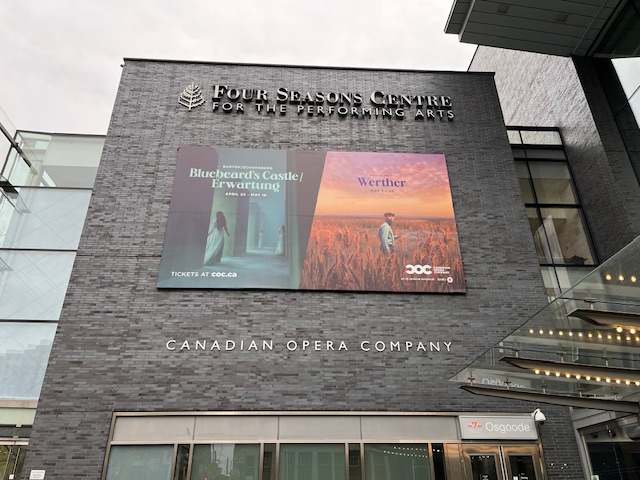
At University and Queen we find the Four Seasons Centre For the Performing Arts. From the outside in the daytime, it’s uninspiring. The entrance looks like a square concrete box. But go inside for an event and enjoy the magnificent glass staircase, and the wood trim which enhance acoustics. Both the Canadian Opera Company and the National Ballet call this centre home.

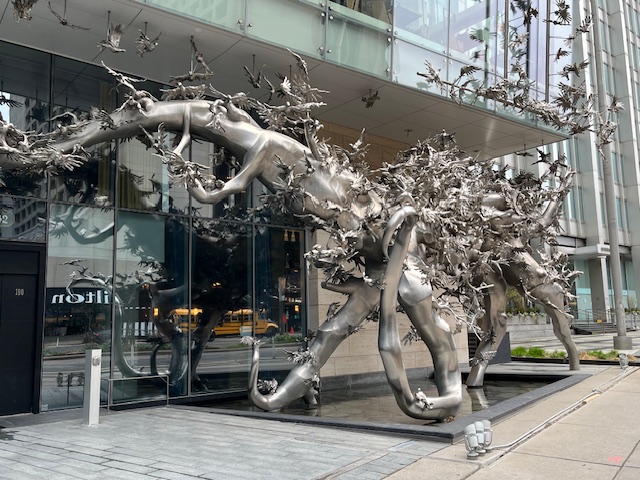
Once again on University Ave, we are attracted to a pile of shiny metal on the right. We cross over again to inspect. In front of the Shangri La hotel stands a sculpture titled Rising. And indeed from some angles a dragon arises. This unique sculpture was designed and built in Shanghai, China, 2012, by artist Zhang Huan. In order to transport it to its destination in Toronto, it had to be disassembled, stored in 15 crates, and delivered by ship. Then it had to be re-assembled! The owner of Summit Metal in the village of Nobleton was selected for this painstaking work. Grant Kimber says it took him over 360 hours to assemble and weld all the pieces, including 300 birds, together.

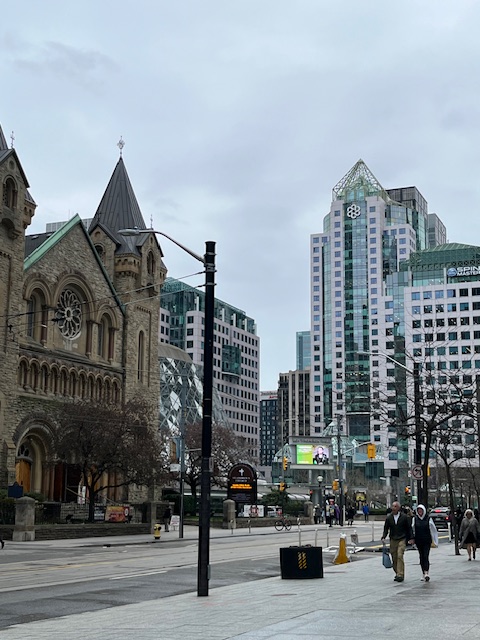
Continuing south we notice the variety of architectural designs. We come upon this streetscape, with an historic church, a couple of modern glass office buildings, Roy Thompson Hall snuggled in between, and Metro Hall in the distance.

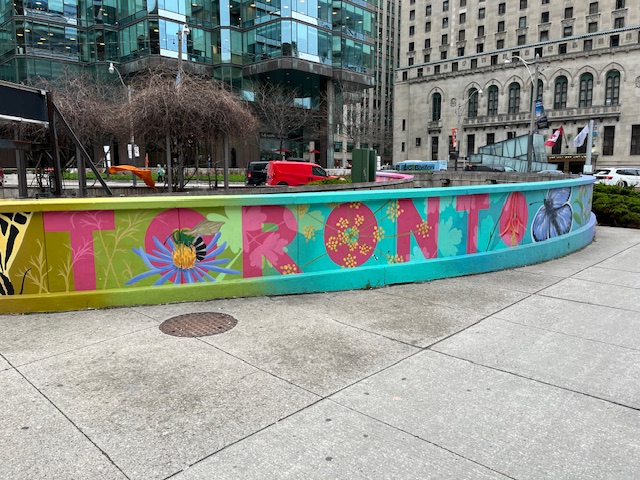
Finally we come to an end of University Ave as it intersects Front St,. For the grand finle we we come to a sweet folk art interpretation of our city:

Sue

Toronto In a Day
Last week we had friends Louis and Dennis, visiting from Ottawa. Since they hadn’t been to Toronto for more than 20 years, they were anxious to see all of our new buildings and attractions. They couldn’t stay very long, so we had just one day to accomplish this.. Peter and I gladly accepted the challenge. We put on our running shoes, packed our umbrellas, and set off. It was just after 10:00 am.

We took our first subway ride from our stop at Old Mill to Bloor and St George. This is near the apartment where Louise and I lived together with another friend while we attended the Ontario College of education. (Three girls living in a tiny apartment with one bathroom is another post entirely, so I’ll move on). The Royal Conservatory Of Music has added Koerner Hall, an ultra-modern concert venue snuggled up beside a majestic old edifice. As we walked farther along Bloor we got to the ROM Crystal. Dennis had read about the controversy surrounding this addition and was anxious to view it for himself. Unfortunately the Crystal, less than 20 years old, is already being reconstructed. Our stop there was short.

Then we took our next subway ride south along University to Dundas. The trip was free since it had been less than 2 hours since our last ride. We walked over to the AGO and discovered that this building too has construction going on inside. And, since our time was limited, the entrance fee of $30 per person seemed a little pricey. Instead, we checked the wood-enhanced lobby and admired the glass and wood facade, all designed by Frank Gehry. Then we walked back to University Ave where we got on the subway, once again for free. We rode south to Union Station and walked down York St. to the waterfront.

Here we stopped to admire Love Park, created by the late Claude Cormier, a well-know landscape artist. Dennis tried to find a tree he could climb so he could take a picture of the heart-shaped pond from above, while the rest of us took in the view of the CN Tower and the boats on the water. Then we walked along the shoreline, all of it newly developed in the last 20 years. We passed unique shops, the market area which is bustling with cultural vents during the summer, and a wave-like sculpture made of wood; every little kid’s dream of a skateboard park. Sadly, skateboarding is prohibited on this piece of art.

Finally we reached our destination; the Amsterdam Brewhouse. This pub/restaurant is a favourite spot for Peter and me during the summer. It has a huge patio along the waterfront with an amazing view of the islands, and the ferries, and the small planes landing at Billy Bishop airport. We got a window seat and ordered beers and lunch. By the time we had finished, it was after 2:00 pm and we had 2 more stops to make. Actually 3, if you count the bathroom.

We walked back to the subway and went north to the stop which Louise and Dennis called Dundas. We had to spend a few minutes explaining that this stop was now TMU, and Dundas Square was now Sankofa. Next Louise and I headed towards the Eaton Centre as Peter and Dennis cried out in horror. They hadn’t realized that this tour included shopping. Really??

Then the truth came out – we were all too tired for shopping or much else. We had walked far more than 10,000 steps. We looked around, found a comfortable bench that would hold 4, and sat there for half an hour. Then we took our 4th subway ride north to College St and ended our tour at one of Canada’s National Historic Sites: the CARLU.

Opened in 1932, this venue, part of the former Eaton’s College St, has hosted Royalty on several occasions. The Round Room, where a Lalique crystal fountain takes centre stage, was a high-end restaurant for many years. The Concert Hall has seen performers like Duke Ellington, Billie Holiday, and Frank Sinatra. Pianist Glen Gould claimed that the acoustics were the best in Canada. The venue is only open for special occasions.

So how did we get in? The Ontario Teachers’ Pension Fund Management team holds an annual meeting there and, since we were all teachers before retiring, we were invited. The meeting was informative and the food and drinks were even better. But what we loved the most, after our busy day, were the sofas! relaxing there was the perfect way to end our tour of Toronto In a Day.

Sue

Snow Man

On Sunday, as the winds howled, and the snow fell for hours, I was stuck inside. l got thinking about a possible topic for today’s post. I almost felt duty-bound to write about the latest shocking murders in Minneapolis. Or maybe I should tell you how “our boys,” the Blue Jays, are taking us to the cleaners with sky-high ticket prices because of last year’s success. Or perhaps I’d give a little jab at any Canadian who dares to criticize Mark Carney’s brilliant speech in Davos.

Then yesterday I changed my mind and grabbed my camera instead. We all awoke to bright sunshine radiating off sparkling piles of snow and I thought “Wow. This is beautiful! How lucky we are to have the change of seasons.” (Of course we also have indoor heating, and warming shelters, lots of salt, ploughs working around the clock to keep us going, and Snow Days. But I digress).

By 9:00 am. our neighbours were all out shovelling – two mothers and a son clearing sidewalks in front of their house, an older man across the street making a space for his car to back out, three teen-agers going house to house looking for shovelling work, and the kids next door heading to the hill with their sleds. Everyone seemed filled with energy.

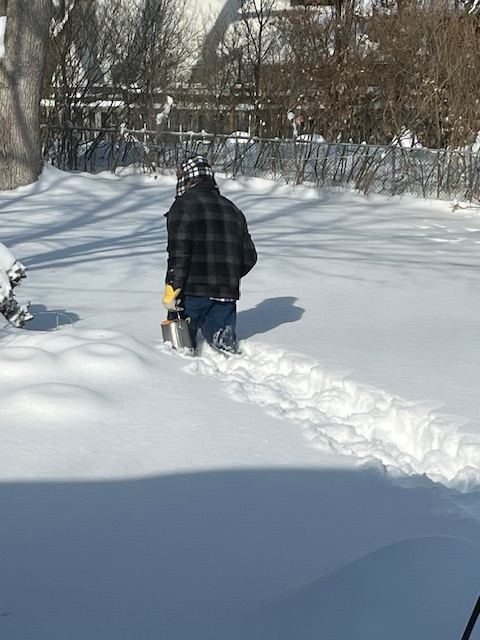
After his second coffee, Peter put on his warm coat, boots and gloves, and even his hat which has been the butt of many jokes. He went out the back door to get his shovel. But where was his shovel? It’s usually standing right beside the back door, within easy reach when needed. But it wasn’t there. Had Canadian Tire run out of shovels and forced someone to steal ours? But there were no tracks. Could a Russian drone have picked it up? Or… could it be buried in a snowbank?

Peter got the kitchen broom from the cupboard and began his search. He brushed off the top step. He brushed his way to the nearby window well, where he spied a bit of red plastic. He inched forward on his knees and reached down. And up came his shovel. After shovelling a pathway to the walk on the side of the house, he gathered up the compost from inside and went cross-country to the big compost bin outside.

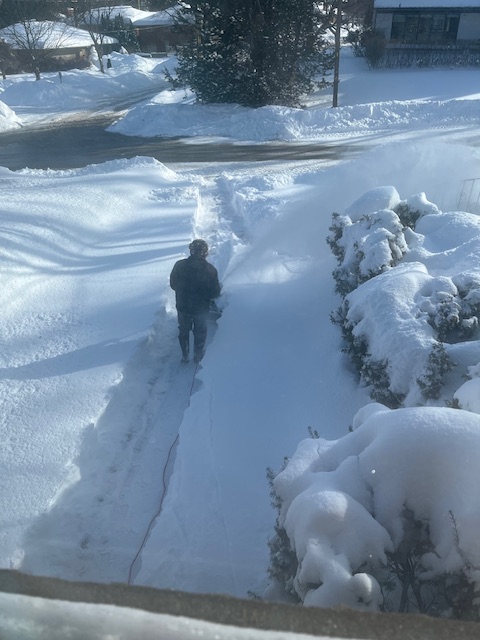
By then Peter was exhausted. He came inside for lunch and a quick nap. But he couldn’t sleep. The driveway was calling him. So he went into the garage and found the snow-blower which his son Daniel had given him several winters ago. It was practically unused. After searching a while for a suitable extension cord, Peter plugged it in and got started. The little snowblower looked a bit anxious about the daunting piles of snow ahead of it, but it chugged forward and back throwing snow to the sides of the driveway. I could almost hear it saying “I think I can, I think I can.”

And together they did. In less than an hour the driveway was cleared, ready for the cars to take us out. The pathway to the front door was cleared, ready for the mailman to bring us more flyers. And Peter had finished his day as the Abominable Snowman.

Yesterday was an exhilarating break from our usual day to day routines and worries, as we gave in to nature’s power; and beauty.

Sue

Old Folks and Newish Buildings

Last week, on one of the many snowy days, Peter and I had to escape. Peter was tired of shoveling and I was tired of cooking. We needed to focus on something besides our TV screen.

A few weeks ago we had seen an article in the Toronto Star which detailed some unique architecture, combining old and new, in downtown Toronto. Why not go and see that? Driving to the GO train or our nearby subway station were not options because our street was not ploughed. So, in a burst of energy, Peter said “Let’s Walk!”

Fortunately he only meant we would walk to the end of our street where we would get a bus to the subway. We bundled up and began our little hike. It was tough going through the snow and up the hill. We were the only people foolish enough to be outside. Just before we reached the bus stop, the bus went by. Was this a sign to turn back?

But we carried on: walking to the next stop and waiting for the next bus to come along. We climbed on thankfully and finished our journey on the subway east and then south. Finally we were downtown at our first building: 2 Queen St West.

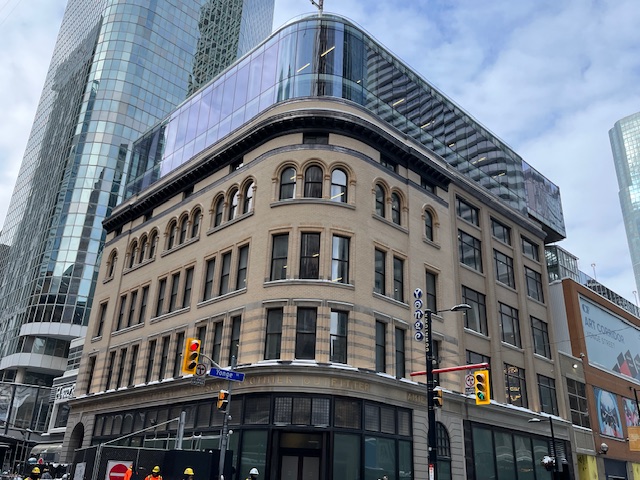
This building is a pleasing mixture of old and new. The old part on the bottom was a men’s clothing store in 1895, then a bank, a record store, and a Woolworth’s. Then, in the mid 1990’s, 2 well-known Toronto architecture firms partnered to design the glass pedestrian bridge over Queen St, and connecting this building to the Toronto Eaton Centre. The glass addition to 2 Queen St. West was an obvious choice. The top is designed as restaurant space but is so far uninhabited.

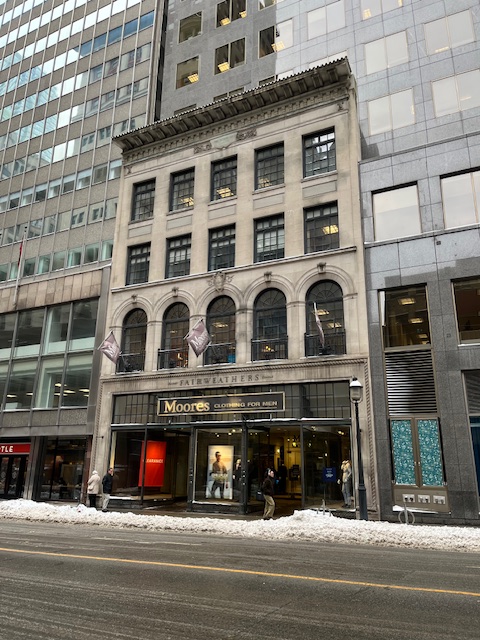
As we waited to make our way south through the slushy Queen-Yonge intersection, we had time to look up. And there was the Bank Of Montreal, built in 1905. The inside lobby is transformed into a trendy restaurant with a walkway to the Toronto underground path. The rest is commercial space. Across the street, we saw the Fairweather Building, constructed in 1897. While the commercial part is now operated by Moore’s clothing store, the beaux arts facade is built into the modern Scotiabank Plaza.

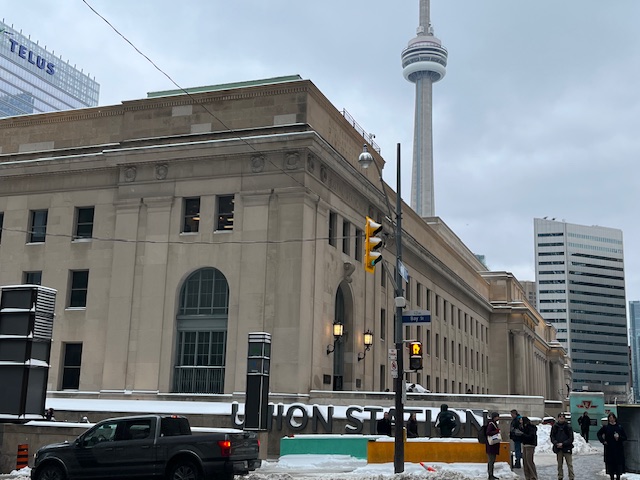
The other buildings on our route were much farther south, on Queen’s Quay. As we wandered along, we admitted that our feet were getting cold from slogging through snow and our stomachs were rumbling too. In a moment of brilliance, we decided to head west on Front St. and visit the most famous Toronto heritage building – Union Station, built between 1914 and 1927.

This heritage treasure, Peter’s first view of Toronto when he came from Italy in 1958, is now surrounded by the CN Tower and glass skyscrapers. One of the other modern aspects of the place is a massive food court in the basement, offering multicultural foods galore. We filled up our stomachs and warmed our feet. Then we stepped onto the subway and went towards home.

The walk from the bus to our house was downhill all the way, as we dreamed of settling on the couch with tea and cookies. Our outside winter adventure had been long enough. The buildings on Queen’s Quay will have to wait till spring.

Stay warm, dear readers.

Sue

Tim’s

Yesterday I took part in a weekly ritual: fitness with friends followed by coffee at Tim Horton’s. As I looked around the restaurant, I wondered how many other people make a visit to Tim’s as part of a routine in their lives. Do you?

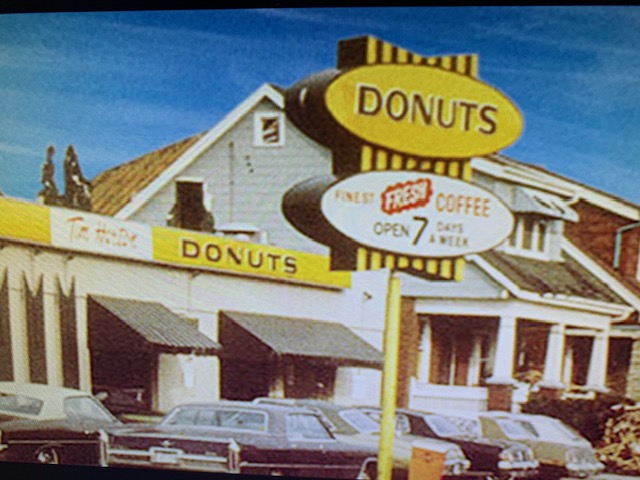
I don’t remember when Tim Horton’s first opened in 1964 as a donut shop in Hamilton:

But I do remember when Tim Horton himself died in 1974, the result of a fiery crash on the QEW near St. Catharines. He was a young hockey star with a wife and family, and the accident was truly tragic. And what was going to happen to those 40 Tim’s locations? Apparently his widow Lori sold them to a business person for $1million plus a Cadillac. Not a great deal in retrospect. Today there are almost 6,000 locations in 13 countries around the world.

Tim’s restaurants have a language all their own. Who doesn’t know what a “double double” is? And “timbits” are a menu staple. As a summer treat, nothing beats an “iced cap.” The line-ups for the pumpkin spiced lattes and muffins in October are long. Everyone grabs a ‘smile cookie” in November to support various charities. Oher holidays such as Valentine’s Day and St. Patrick’s Day have their specially-named treats also.

Every Monday afternoon my 3 friends and I rush out of fitness class, grab our warm coats and drive to our favourite Tim’s location. We try to beat the crowds so we can have the table and chairs in front of the fireplace. It’s an electric fireplace which doesn’t emit any heat. But sitting there on Blue Monday feels warm and cozy when the outside temperature is minus 20. We take on world issues – climate change, politics, and of course gossip – while relaxing in the padded chairs. Not too much gets resolved but we have a great time pretending we are world leaders.

Occasionally I have a chance to look around. The clientele is varied: a university student glued to his laptop as he does his research, a mother and 2 squabbling kids escaping from their home on a PD Day, a wannabe applicant trying to score points with her prospective boss, 2 couples following the rules of social engagement for older people.

Tim’s performs a lot of services for a lot of us. Think of all the folks who hurry to a location to buy cards for stocking stuffers, a last-minute gift for the mail carrier, an extra prize for a raffle at work. In fact this past Christmas Peter, mindful of my Monday addiction, bought me a Tim’s card for $100, all his shopping problems solved with one quick stop.

But Tim’s failed us in Portugal recently. We arrived in Porto late one evening for a couple of days’ stay. The next morning we were hungry and needed a quick bite before our first activity. Where was a Tim’s when we needed it? Well, apparently Portugal is one of the few places in the world where Tim’s has not gone. So we were directed to the local – dare I say it – McDonald’s!

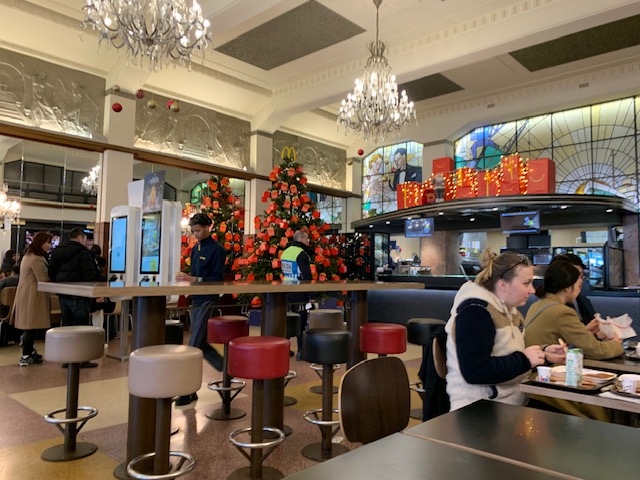
This was a McDonald’s like no other. The entrance is embellished with a large spread-winged eagle. The furniture is modern and sleek. The ordering is all online. The inside was decorated with a Christmas tree and packaged gifts. And overhead? Crystal chandeliers. How could Tim Horton’s ever compete with that?

Sue

A Square To Be Proud Of

In 2021 the Canadian government voted to mark an official Day Of Truth and Reconciliation, on September 30. This September a new installation was opened in Nathan Phillis Square, Toronto. Last week we decided to investigate this new Spirit Garden.

We took the Yonge subway to Dundas and wandered through the Eaton Centre, stopping for lunch at the Food Court and remarking, as we headed through the shopping maze, that neither Peter nor I had been to Nathan Phillips Square in Ages. We have visited on a few occasions such as New Year’s Eve, but mostly we have used the square as a short-cut between Yonge St And University Ave.

This time we entered from the east side and had to weave through a lot of props, signage and equipment, as we made our way to the south-west corner of the square. Construction workers and event planners were setting up for the Diwali Festival Of Lights, happening on the weekend.

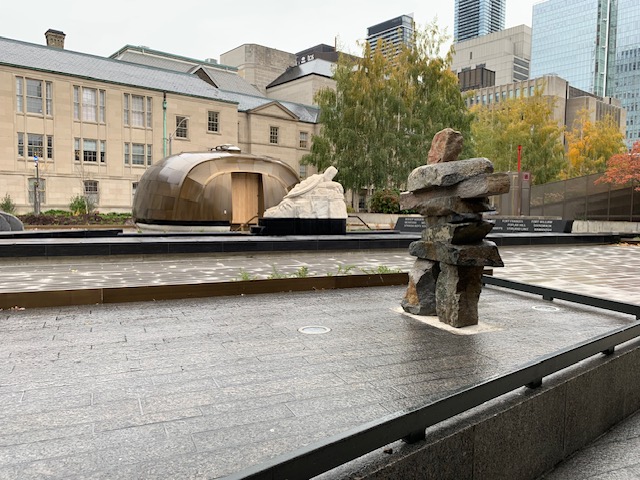
Then a series of new installations, the Spirit Garden, caught our eye. Attracting us first was a large turtle, symbolizing the First Mother. She is labouring up a hill, a look of determination on her face. She represents the Indigenous people struggling against land and cultural appropriation, evidenced by the residential school tragedy. The turtle is staring at the roadblock of listed schools in its path.

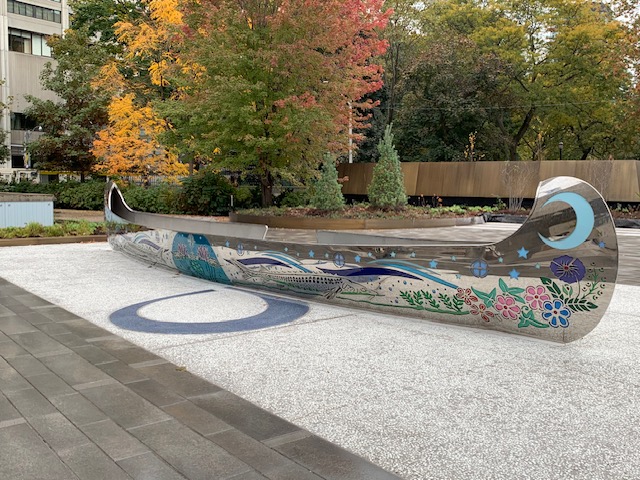
On one side of the turtle’s journey sits a large inuksuk, (a human-like figure guiding travellers and warning of danger ahead) and on the other side a shiny copper teaching lodge, built to be an Indigenous classroom. Nearby rests a canoe, symbolic of early travel from the north along Carrying Place, to the Great Lakes. Unlike practical vessels, this one is shimmering stainless steel with colourful patterns etched on its sides.

At one end of the Spirit Garden, a natural garden features crops of the 3 sisters: corn with its tall stalks planted at the back, beans next, using the corn stalks as support, and squash for groundcover to keep the weeds out and moisture in. These 3 vegetables are often cooked and served together in an Indigenous meal.

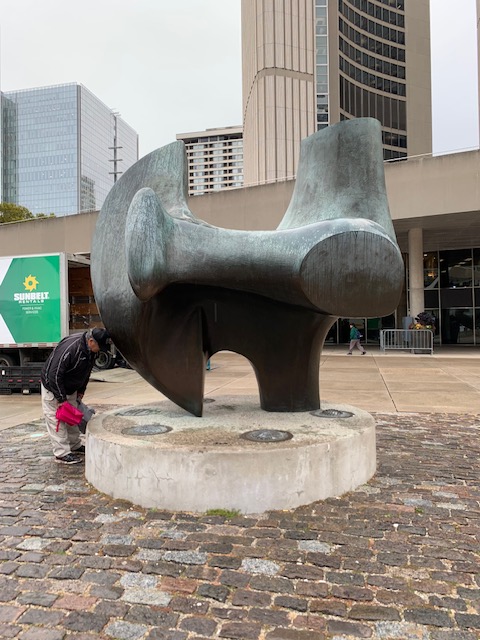
Satisfied with our tour of this new garden, we decided to explore the square a little further. Built in 1965, on land originally occupied by Chinese and Jewish immigrants, the square was named after former Mayor Nathan Phillips and placed adjacent to the new Toronto City Hall. In the northwest corner of the square a reflecting pool and eternal flame highlight a Peace Garden. A Henry Moore Sculpture has also resided here for over 60 years. A statue of Winston Churchill was added in 1977.

Around 2010 the city decided that a facelift was in order. A design concept, based on the ancient Greek “agora,” a large gathering place and market, led to the changes. A new restaurant with a rooftop patio replaced the old skate shack. Now it’s an updated eatery beside the skating rink, which features a colourful Toronto sigh, installed during the 2015 Pan Am Games. One of the Freedom Arches above the rink contains a piece of the Berlin wall at its base.

In the centre of the square a new stage was built to replace the temporary structures used for concerts and special events. This stage area, referred to as the Podium, has a “green” roof and feels very open and welcoming.

In fact, the entire area of Nathan Phillips Square feels welcoming. Whether you are a politician, a skater, a concert-goer, a Raptors fan, a shopper, a tourist, or an Indigenous person, there is a place for you there.

Sue

Canadian Chroma

Are the advantages of living in a big city worth the aggravations that sometimes happen? Last weekend we got to find out.

We took the subway to the Eaton Centre, the busiest shopping mall in all of Canada, with over 50 million visitors annually. Built in the 1970’s, it has been anchored by at least one major department store during most of its life. But that all changed when Nordstrom recently moved out.

The same thing has been happening to other malls across Canada and the US. Competition from Amazon and other online stores has drastically reduced in-person shopping. Sherway Gardens filled up vacated retail space with unique Christmas Markets. Another mall near us, Cloverdale, replaced a big Target store with – wait for it – pickleball courts! What would the Eaton Centre come up with to replace Nordstrom’s footprint? We read about it in the newspaper: Canadian Chroma.

Soon after we arrived at the Eaton Centre, the fire alarm began to beep at us. Shoppers stopped in their tracks, waiting patiently until we got the ‘all clear’ signal several minutes later. After lunch, Peter went to the washroom and came out reporting that a guy in one of the stalls was having a melt-down and the bathroom was full of security guards.

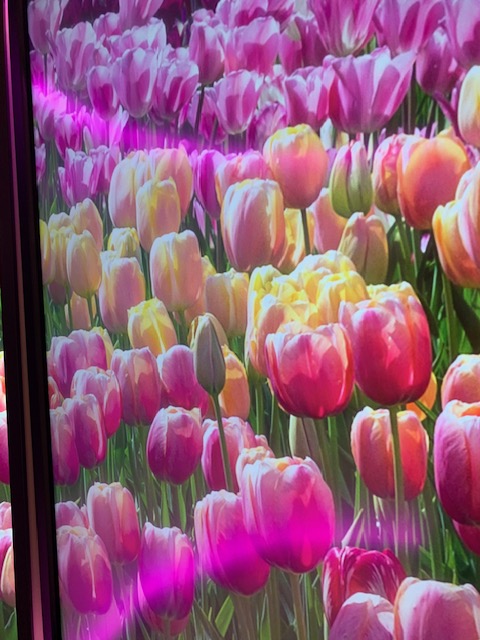
Finally we found our way safely to the new exhibit, a series of interactive displays highlighting the beautiful colours of our Canadian geography. The first stop shows dramatic photographs from coast to coast to coast: the majestic mountains of the north and west covered in sparkly snow, the golden wheat fields of Alberta and Saskatchewan ready for harvesting, the forests of Ontario dressed in autumn colours, the turqouise-blue waters of the maritime provinces. There are hundreds of photos in gorgeous hues; available by touching a colour and then a button.

Here’s one of the buttons between pink and coral:

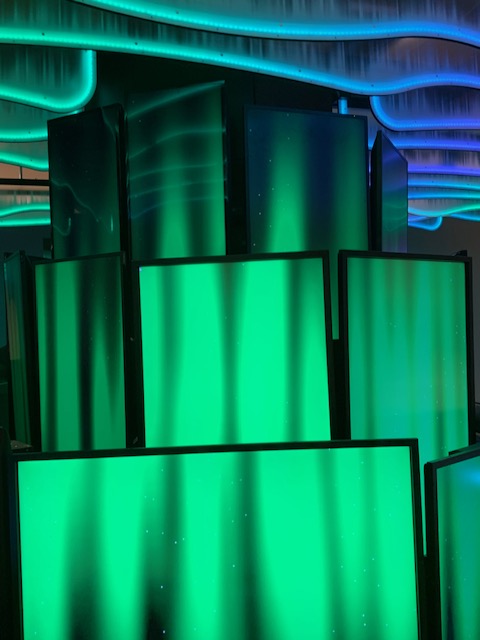
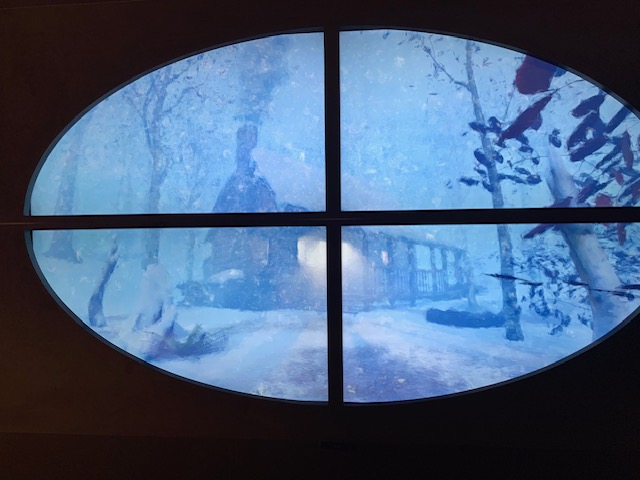
The second stop in the display shows 4 photos of a log farmhouse from a nearby window, in all 4 seasons. The third stop depicts the Northern Lights in beautiful shades of green. The viewer stands on a set of footprints in front of the lights which respond to body movements with bubble columns and explosions.

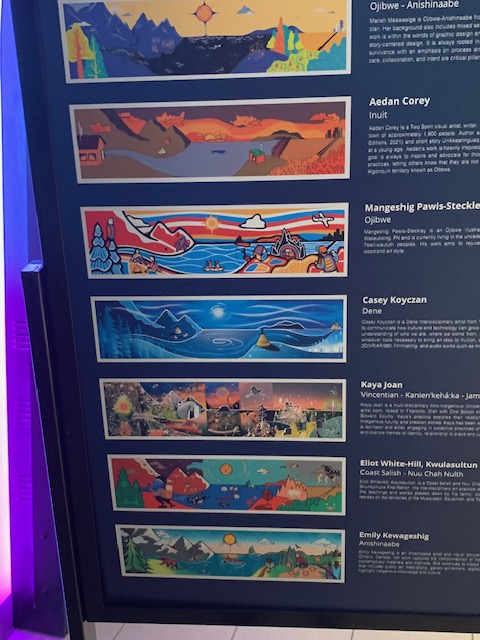
Display number 4 promotes Indigenous art in a unique and fun way. There are 7 murals painted by 7 different artists, each divided into 7 panels. Viewers can mix and match the panels to create one entire mural by one artist or, if you have the patience, up to 49 different murals with 1 panel from each artist. It would be a good way to entertain grandchildren for quite a while.

(Here is your cheat sheet for the murals):

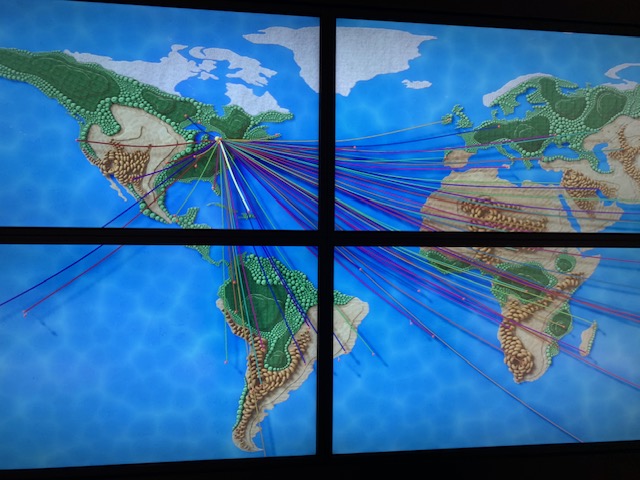
The final display is an interactive map showing where we Canadians originally came from. Virtual threads in different colours link places in Canada to other places around the world. For example, Peter found a fuscia thread connecting Toronto to Italy. He was so pleased to see his journey on display. All in all, Canadian Chroma was well worth a visit. And it was free!

Then we headed for home.

When we got to our subway station, the line was closed to sort out a security issue. We decided to walk south to Queen, and take a streetcar west to the University line. At Queen we discoveed that the streetcars were not running due to construction. So we had to walk to King, and then along King to the next streetcar stop. Finally we found a streetcar, and another subway, and then home.

Were the security issues, the costruction, and the subway delays stressful? Well they did slow us down. But heck, we are retired – we have the time. That seems a small price to pay for experiencing life in a big city.

Sue

PS Since our winter in Toronto seems to have passed with barely a dusting of snow so far, I thought you’d like to see this photo from the exhibit:

Heliconian

Come on, admit it. You remember Yorkville during the 1960’s too! We were either in university or checking out the job market. On Friday nights we went to Yorkville to see Gordon Lightfoot, or Joni Mitchell, or even Neil Young at the Riverboat or one of the other clubs or coffee shops that popped up during that intoxicating decade. After that we moved on to building careers and raising children, while Yorkvillke went downhill when biker gangs and drug dealers moved in.

Soon the new Bloor-Danforth subway line enticed high-end businesss, and a new class of patrons, rich shoppers, started coming by. That area is now referred to as the “mink mile.” Stores like Versace, Louis Vutton and Cartier sell exclusive items, and restaurants serve the latest in food trends, with a negroni cocktail, and a serving of kale on the side.

Through all of this a lot of renovation and rebuilding has taken place. But there are still a few old gems hanging around. The Yorkville Library at 229 Yorkville Ave is one of the earliest branches of the city library system, designed in 1929 in the Carnegie architectural style. The first site of Mount Sinai Hospital, built in 1923 at 100 Yorkville Ave, is now a trendy store.

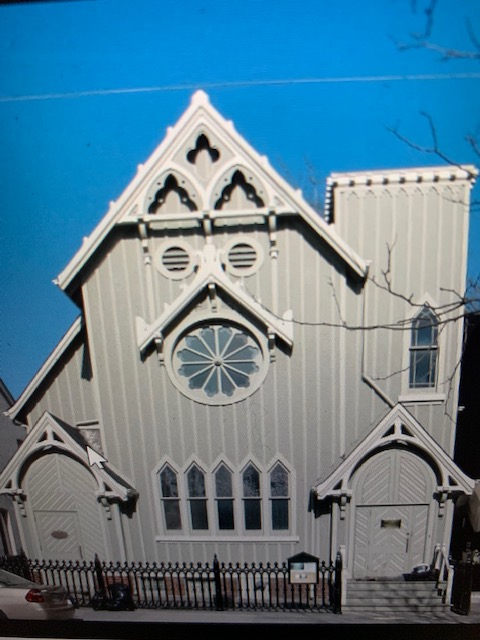
My favourite old building is the Heliconian Hall at 35 Hazleton Ave. Originally a Baptist Church built in 1875, it was bought by a feisty group of women who had founded an arts group in 1909 and were loking for a permanent home. The building, designed in a style referred to as Carpenter Gothic, ie Gothic in wood, is the oldest building standing in Yorkville.

Inside the building that feisty group of women, or nowadays their grand daughters, still run an active arts program open to the public. The name comes from Mount Heliconian in Greece, said to be a source of poetic inspiration for the muses. There are concerts, performances, and art shows on a regular basis. And the best known? A literary lecture series once a month. The club invites Canadian authors with recently-published books to come and speak to an audience of about 150. There are rarely any empty seats.

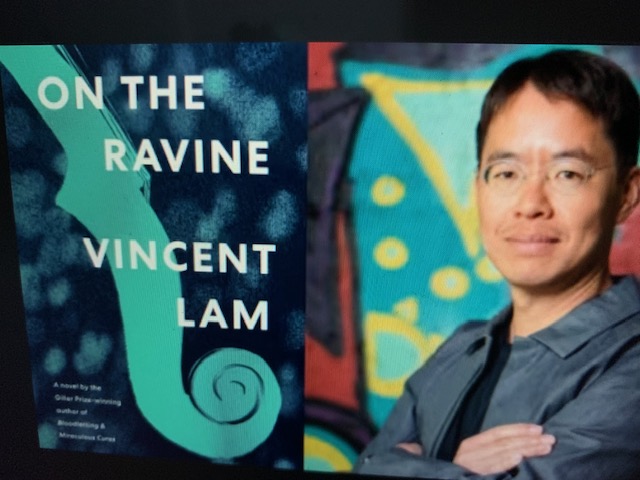
I have seen many reputable authors there. Marie Henein comes to mind. She was the laywer for that controversial case involving Jian Ghomeshi a few years ago. I expectd her to be another feisty woman. And she was! I also heard Ann-Marie MacDonald and Wayne Johnston, 2 Canadian authors whose fame is well-known, even in the US. Later this season we are being treated to a lecture by Dr. Vincent Lam who now spends a lot of his spare time writing. His latest novel takes place in a Toronto ravine and deals with a timely subject – drug overdosing.

I attend these presentations with an old friend who shares my love of writing. On our subway trips we discuss our latest novels, stories and yes, even blog posts! When the subway arives at our stop, we have a short walk through Yorkville, beautifully lit up at night, until we arrive at Heliconain Hall. We share tea and cookies with other members of the audience. Then we all settle in for the lecture and audience questions.

What better way to spend a winter evening? Friendship, food and our favourite Canadian writers, in an historic setting.

Sue