
When Mayor-elect Olivia Chow gave her acceptance speech on June 26, she spoke passionately about growing up as an immigrant in an east-end community called St. James Town. This was her first home in her new country. And Peter and I had never been there.
On a recent Friday we took the subway to Sherbourne Station and walked south. We were soon overtaken by high-rise buildings, 19 of them, as low as 15 storeys, rising up to 30. The apartments were on a large plot of land between Sherbourne on the west side and Parliament on the east, with Bloor St to the north and Carlton on the south. They seemed to be rentals, some of them subsidized. This was clearly not an accident. Could it be the answer to Toronto’s current housing shortage? We decided to explore further.

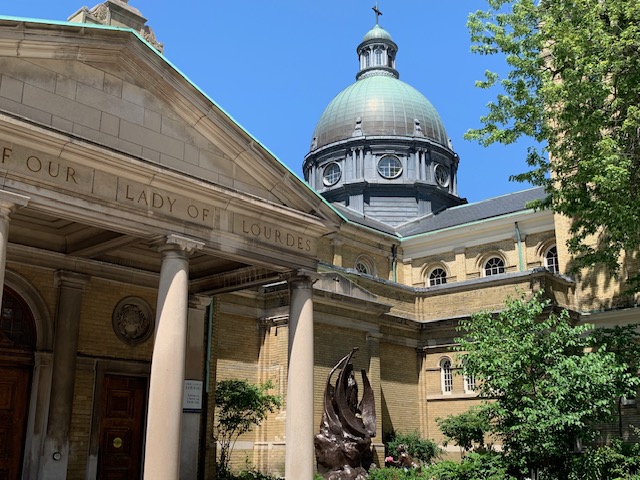
With the help of a book, Toronto Art Strolls, we searched for some treasures. We found a forest walk edged in painted steel panels, separated by coloured glass ones, depicting a day in the life of a 19th century resident. We discovered a unique trompe l’oeil art piece on a brick wall and had to stop ourselves from trying to walk through to the painted patio. We visited a Catholic Church built in 1886 with a beautiful dome over the altar. We stared up at a mural painted on one of the towers which, according to Guinness, is the tallest mural in the world.

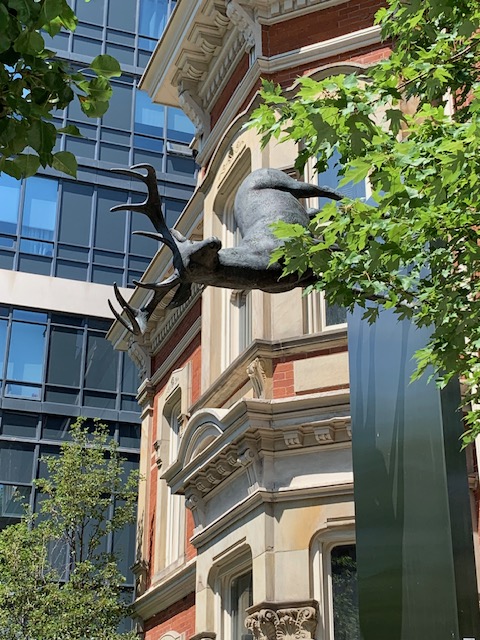
We looked high and low for a collection of steel animals on the property of a still-standing Victorian mansion. Finally we asked a clerk at a local convenience store if she knew where the fox and reindeer were. She giggled and told us: “No animal in city. This is city. You go to country – find animals.” But we persevered and soon discovered a wonderful collection perched on pedestals and hanging from the bricks of a beautiful home erected in 1881.
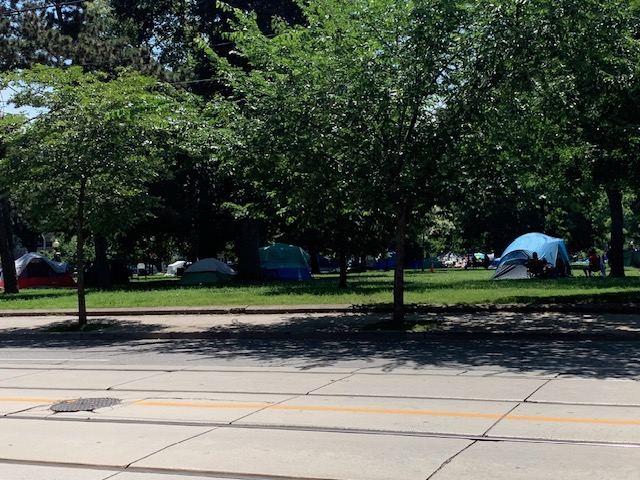
But all was not as it seemed in this little “art gallery” corner of Toronto. Walking farther south on Sherbourne, we began to see groups of unkempt, unshaven men, young and old, all races, most of them smoking cigarettes, some sitting on the curb, some wandering aimlessly. Across the street in Allan Gardens we discovered a tent city, and farther down at a church, a long line of food bank customers. How had this middle-class Victorian neighbourhood changed so drastically?
Apparently the first settlement,, called St. James Town, began in the 1800’s as a suburb of downtown Toronto, inhabited by middle-class families in single family homes. It stayed that way until the 1950’s when some Victorian homes began to deteriorate and were replaced by high-rise towers, in an attempt to attract a greater number of middle-class workers to the city. But the area lacked amenities needed for such density and the apartments failed to attract the middle class. Now, in the 21st century, the towers are inhabited by the lower class and struggling new immigrants. Although a library has been built and there are some green spaces, there are still many services missing. And inflation, especially the cost of food, is hitting the area hard.
Developers have recently come up with a plan that might help to solve this issue. They call it “mini-cities.” High rise towers are surrounded by, or in the middle of, shopping malls which include the facilities and services needed for the nearby population: low-budget grocery stores, dollar stores, immigrant services, medical clinics, a community hub for playing cards or gathering together with friends for a coffee. A home where living is comfortable instead of a box where life is bleak.
With a redo like this, could St. James Town rise again?
Sue
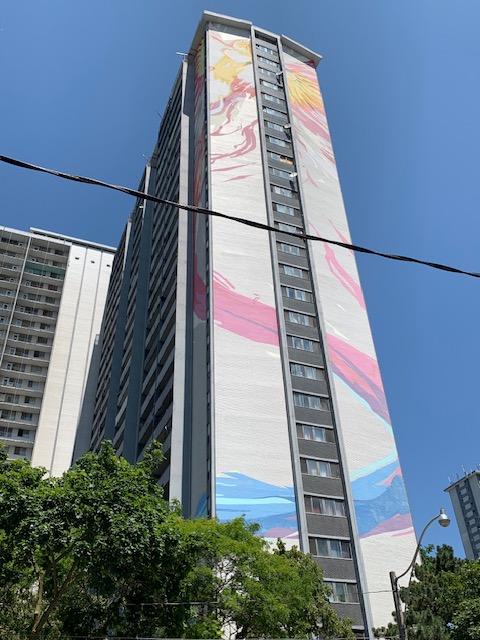
Possibly the tallest mural in the world, according to Guinness, is located in St. James Town


Another wonderful article, Sue. You and Peter are always exploring, learning. I really admire (and miss) that. I very much agree with you and have often schemed and plotted even designed a community of housing for the disenfranchised exactly as you described it. There are plenty of buildings that could lend themselves to conversion more economically than new-builds cost. And perhaps, if run by resident committees (with professional help) could feel like home and be safe and even enriching.
LikeLike
Thank you for all this information. You take us to new places. That is very appreciated.
LikeLike