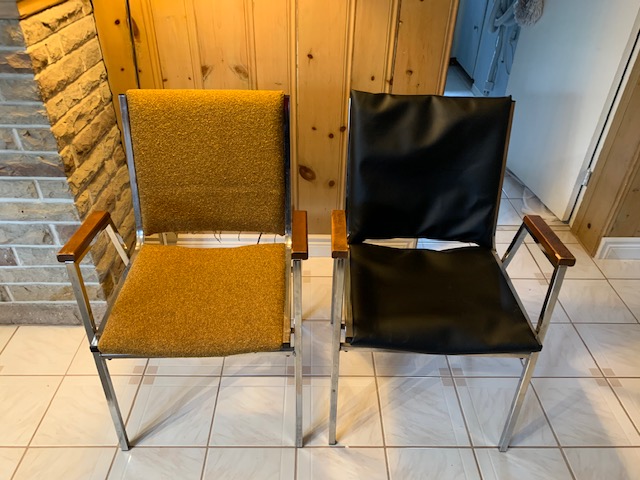
Last week I wrote about my chair-recovering project. I thought it went quite well, actually. But that’s Not what readers said. The comments went from kind but condescending to outright scathing! One reader suggested that my recovered chairs were not nearly as beautiful as the originals. Really? Another reader went to great lengths to suggest that the recovered chairs would not be as comfortable because the softer, more porous, gold material was more forgiving of various bodily emanations which one might wish to hide. I have to admit I hadn’t thought of that.
So where to go from here? How to hide my shame? One thing I do know is that projects are helpful in staving off the emotions we are currently feeling. A recent article mentions that most of us are not depressed, but neither are we flourishing. The author calls it “languishing” as in hanging around, accomplishing nothing, nada. Just waiting for… something, but what? On that note, I hereby present another covid project:
After we moved to the city, I decided to explore my interest in learning how to speak Italian. Peter is Italian and speaks his native language fairly well, although much too fast for a beginner like me. “Lentemente, Pietro!” I considered my options and chose a class at a nearby adult learning centre. We studied some Italian culture and at a lot of biscotti. But as for actually speaking? Nothing. Niente.
When the pandemic hit, the class, like everything else, got cancelled. I was relieved, honestly. But then the boredom wore me down and I went searching for a different kind of class; a more interactive one, with more speaking. Eventually I signed up for a U of T Italian general interest class. Online Monday evenings. Perfect, I thought.
The course platform was Zoom. I have used Zoom a few times, for book clubs and family visits. I know how to sign in, turn on my audio and visual, raise my hand (virtually). What more could there be? I soon found out. At the beginning of the first class, the instructor, Lorenzo, put a document on the screen and asked us to download it, fill in the answers, and share our screen. I didn’t know how to do Any of this. Zoom was turning out to be harder than Italian!
Fortunately, I was in luck. Several of the other students in the class were younger than me (not hard to imagine) and most of them still worked in the daytime, online, using Zoom. When we were in our breakout rooms, something else I had not experienced, they happily shared their screens with me and did the filling-in part. I did my share by contributing a lot of the answers. It seemed to work OK.
The 10 weeks went by quickly and I had a lot of experience speaking. We supplemented our class time with work in an interactive text book and taped dialogues. We covered the material in 3 chapters. I am still not good at rolling my “r’s” but I have mastered a few verb tenses and learned some new vocabulary. Feeling very proud of myself for accomplishing something – learning Italian And Zoom – I signed up for level 2.
The first class of level 2 was last night. The new instructor, Tanizio, introduced the two groups of students to each other – Lorenzo’s level one students, and Tanizio’s level one students. Then he announced that we would be starting level 2 with chapter 6 from the textbook. Mamma Mia! How had we, Lorenzo’s students, managed to skip chapters 4 and 5? I could feel my anxiety rising. Should I give up now while a refund is still available?
NO! I should not. And neither should you. Get that new project going. Whether it’s recovering furniture, or planting a new kind of shrub, or baking cookies for the neighbours, we all need a sense of purpose. Find one and share it with us. No languishing allowed!
Sue




 Seventy In the City